Type a math problem or upload a photo, screenshot, handwritten question...
error msg
- Algebra
- Calculus
- Trigonometry
- Matrix
- Differential
- Integral
- Trigonometry
- Letters
Question
y=2x^{2}+8x+7
Function
-
Find the vertex
-
Find the axis of symmetry
-
Rewrite in vertex form
-
Evaluate the derivative
-
Find the domain
-
\text{Find the }x\text{-intercept/zero}
-
Find the y-intercept
-
Find the critical numbers
-
Find the local extrema
-
Find the increasing or decreasing interval
-
Find the range
-
Find the vertical asymptotes
-
Find the horizontal asymptotes
-
Find the oblique asymptotes
-
Determine if even, odd or neither
-
Find the stationary points
-
Find the inflection points
More methods
Hide more
\left(-2,-1\right)
Evaluate
y=2x^{2}+8x+7
\text{Find the }x\text{-coordinate of the vertex by substituting a=}2\text{ and b=}8\text{ into }x\text{ = }-\frac{b}{2a}
x=-\frac{8}{2\times 2}
\text{Solve the equation for }x
x=-2
\text{Find the y-coordinate of the vertex by evaluating the function for }x\text{=}-2
y=2\left(-2\right)^{2}+8\left(-2\right)+7
Calculate
More Steps
Evaluate
2\left(-2\right)^{2}+8\left(-2\right)+7
Multiply the terms
More Steps
Evaluate
2\left(-2\right)^{2}
Calculate the product
-\left(-2\right)^{3}
A negative base raised to an odd power equals a negative
2^{3}
2^{3}+8\left(-2\right)+7
Multiply the numbers
More Steps
Evaluate
8\left(-2\right)
Multiplying or dividing an odd number of negative terms equals a negative
-8\times 2
Multiply the numbers
-16
2^{3}-16+7
Evaluate the power
8-16+7
Calculate the sum or difference
-1
y=-1
Solution
\left(-2,-1\right)
Show Solutions
Testing for symmetry
-
Testing for symmetry about the origin
-
Testing for symmetry about the x-axis
-
Testing for symmetry about the y-axis
\textrm{Not symmetry with respect to the origin}
Evaluate
y=2x^{2}+8x+7
\text{To test if the graph of }y=2x^{2}+8x+7\text{ is symmetry with respect to the origin,substitute -x for x and -y for y}
-y=2\left(-x\right)^{2}+8\left(-x\right)+7
Simplify
More Steps
Evaluate
2\left(-x\right)^{2}+8\left(-x\right)+7
Multiply the terms
2x^{2}+8\left(-x\right)+7
Multiply the numbers
2x^{2}-8x+7
-y=2x^{2}-8x+7
Change the signs both sides
y=-2x^{2}+8x-7
Solution
\textrm{Not symmetry with respect to the origin}
Show Solutions
Identify the conic
-
Find the standard equation of the parabola
-
Find the vertex of the parabola
-
Find the focus of the parabola
-
Find the directrix of the parabola
More methods
Hide more
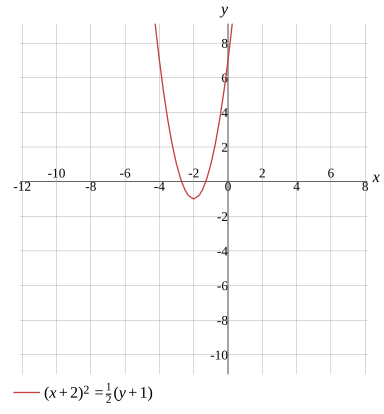
\left(x+2\right)^{2}=\frac{1}{2}\left(y+1\right)
Evaluate
y=2x^{2}+8x+7
Swap the sides of the equation
2x^{2}+8x+7=y
Move the constant to the right-hand side and change its sign
2x^{2}+8x=y-7
\text{Multiply both sides of the equation by }\frac{1}{2}
\left(2x^{2}+8x\right)\times \frac{1}{2}=\left(y-7\right)\times \frac{1}{2}
Multiply the terms
More Steps
Evaluate
\left(2x^{2}+8x\right)\times \frac{1}{2}
Use the the distributive property to expand the expression
2x^{2}\times \frac{1}{2}+8x\times \frac{1}{2}
Multiply the numbers
x^{2}+8x\times \frac{1}{2}
Multiply the numbers
x^{2}+4x
x^{2}+4x=\left(y-7\right)\times \frac{1}{2}
Multiply the terms
More Steps
Evaluate
\left(y-7\right)\times \frac{1}{2}
Apply the distributive property
y\times \frac{1}{2}-7\times \frac{1}{2}
Use the commutative property to reorder the terms
\frac{1}{2}y-7\times \frac{1}{2}
Multiply the numbers
\frac{1}{2}y-\frac{7}{2}
x^{2}+4x=\frac{1}{2}y-\frac{7}{2}
To complete the square, the same value needs to be added to both sides
x^{2}+4x+4=\frac{1}{2}y-\frac{7}{2}+4
\text{Use }a^2+2ab+b^2=(a+b)^2\text{ to factor the expression}
\left(x+2\right)^{2}=\frac{1}{2}y-\frac{7}{2}+4
Add the numbers
More Steps
Evaluate
-\frac{7}{2}+4
Reduce fractions to a common denominator
-\frac{7}{2}+\frac{4\times 2}{2}
Write all numerators above the common denominator
\frac{-7+4\times 2}{2}
Multiply the numbers
\frac{-7+8}{2}
Add the numbers
\frac{1}{2}
\left(x+2\right)^{2}=\frac{1}{2}y+\frac{1}{2}
Solution
\left(x+2\right)^{2}=\frac{1}{2}\left(y+1\right)
Show Solutions
Solve the equation
\begin{align}&x=\frac{\sqrt{2+2y}-4}{2}\\&x=-\frac{\sqrt{2+2y}+4}{2}\end{align}
Evaluate
y=2x^{2}+8x+7
Swap the sides of the equation
2x^{2}+8x+7=y
Move the expression to the left side
2x^{2}+8x+7-y=0
Move the constant to the right side
2x^{2}+8x=0-\left(7-y\right)
Add the terms
2x^{2}+8x=-7+y
Evaluate
x^{2}+4x=\frac{-7+y}{2}
Add the same value to both sides
x^{2}+4x+4=\frac{-7+y}{2}+4
Evaluate
x^{2}+4x+4=\frac{1+y}{2}
Evaluate
\left(x+2\right)^{2}=\frac{1+y}{2}
Take the root of both sides of the equation and remember to use both positive and negative roots
x+2=\pm \sqrt{\frac{1+y}{2}}
Simplify the expression
More Steps
Evaluate
\sqrt{\frac{1+y}{2}}
To take a root of a fraction,take the root of the numerator and denominator separately
\frac{\sqrt{1+y}}{\sqrt{2}}
Multiply by the Conjugate
\frac{\sqrt{1+y}\times \sqrt{2}}{\sqrt{2}\times \sqrt{2}}
Calculate
\frac{\sqrt{1+y}\times \sqrt{2}}{2}
Calculate
More Steps
Evaluate
\sqrt{1+y}\times \sqrt{2}
The product of roots with the same index is equal to the root of the product
\sqrt{\left(1+y\right)\times 2}
Calculate the product
\sqrt{2+2y}
\frac{\sqrt{2+2y}}{2}
x+2=\pm \frac{\sqrt{2+2y}}{2}
\text{Separate the equation into }2\text{ possible cases}
\begin{align}&x+2=\frac{\sqrt{2+2y}}{2}\\&x+2=-\frac{\sqrt{2+2y}}{2}\end{align}
Calculate
More Steps
Evaluate
x+2=\frac{\sqrt{2+2y}}{2}
Move the constant to the right-hand side and change its sign
x=\frac{\sqrt{2+2y}}{2}-2
Subtract the terms
More Steps
Evaluate
\frac{\sqrt{2+2y}}{2}-2
Reduce fractions to a common denominator
\frac{\sqrt{2+2y}}{2}-\frac{2\times 2}{2}
Write all numerators above the common denominator
\frac{\sqrt{2+2y}-2\times 2}{2}
Multiply the numbers
\frac{\sqrt{2+2y}-4}{2}
x=\frac{\sqrt{2+2y}-4}{2}
\begin{align}&x=\frac{\sqrt{2+2y}-4}{2}\\&x+2=-\frac{\sqrt{2+2y}}{2}\end{align}
Solution
More Steps
Evaluate
x+2=-\frac{\sqrt{2+2y}}{2}
Move the constant to the right-hand side and change its sign
x=-\frac{\sqrt{2+2y}}{2}-2
Subtract the terms
More Steps
Evaluate
-\frac{\sqrt{2+2y}}{2}-2
Reduce fractions to a common denominator
-\frac{\sqrt{2+2y}}{2}-\frac{2\times 2}{2}
Write all numerators above the common denominator
\frac{-\sqrt{2+2y}-2\times 2}{2}
Multiply the numbers
\frac{-\sqrt{2+2y}-4}{2}
\text{Use }\frac{-a}{b}=\frac{a}{-b}=-\frac{a}{b}\text{ to rewrite the fraction}
-\frac{\sqrt{2+2y}+4}{2}
x=-\frac{\sqrt{2+2y}+4}{2}
\begin{align}&x=\frac{\sqrt{2+2y}-4}{2}\\&x=-\frac{\sqrt{2+2y}+4}{2}\end{align}
Show Solutions
Rewrite the equation
\begin{align}&r=\frac{\sin\left(\theta \right)-8\cos\left(\theta \right)-\sqrt{1+7\cos^{2}\left(\theta \right)-8\sin\left(2\theta \right)}}{4\cos^{2}\left(\theta \right)}\\&r=\frac{\sin\left(\theta \right)-8\cos\left(\theta \right)+\sqrt{1+7\cos^{2}\left(\theta \right)-8\sin\left(2\theta \right)}}{4\cos^{2}\left(\theta \right)}\end{align}
Evaluate
y=2x^{2}+8x+7
Move the expression to the left side
y-2x^{2}-8x=7
\text{To convert the equation to polar coordinates,substitute }r\cos\left(\theta \right)\text{ for }x\text{ and }r\sin\left(\theta \right)\text{ for }y
\sin\left(\theta \right)\times r-2\left(\cos\left(\theta \right)\times r\right)^{2}-8\cos\left(\theta \right)\times r=7
Factor the expression
-2\cos^{2}\left(\theta \right)\times r^{2}+\left(\sin\left(\theta \right)-8\cos\left(\theta \right)\right)r=7
Subtract the terms
-2\cos^{2}\left(\theta \right)\times r^{2}+\left(\sin\left(\theta \right)-8\cos\left(\theta \right)\right)r-7=7-7
Evaluate
-2\cos^{2}\left(\theta \right)\times r^{2}+\left(\sin\left(\theta \right)-8\cos\left(\theta \right)\right)r-7=0
Solve using the quadratic formula
r=\frac{-\sin\left(\theta \right)+8\cos\left(\theta \right)\pm \sqrt{\left(\sin\left(\theta \right)-8\cos\left(\theta \right)\right)^{2}-4\left(-2\cos^{2}\left(\theta \right)\right)\left(-7\right)}}{-4\cos^{2}\left(\theta \right)}
Simplify
r=\frac{-\sin\left(\theta \right)+8\cos\left(\theta \right)\pm \sqrt{1+7\cos^{2}\left(\theta \right)-8\sin\left(2\theta \right)}}{-4\cos^{2}\left(\theta \right)}
\text{Separate the equation into }2\text{ possible cases}
\begin{align}&r=\frac{-\sin\left(\theta \right)+8\cos\left(\theta \right)+\sqrt{1+7\cos^{2}\left(\theta \right)-8\sin\left(2\theta \right)}}{-4\cos^{2}\left(\theta \right)}\\&r=\frac{-\sin\left(\theta \right)+8\cos\left(\theta \right)-\sqrt{1+7\cos^{2}\left(\theta \right)-8\sin\left(2\theta \right)}}{-4\cos^{2}\left(\theta \right)}\end{align}
\text{Use }\frac{-a}{b}=\frac{a}{-b}=-\frac{a}{b}\text{ to rewrite the fraction}
\begin{align}&r=\frac{\sin\left(\theta \right)-8\cos\left(\theta \right)-\sqrt{1+7\cos^{2}\left(\theta \right)-8\sin\left(2\theta \right)}}{4\cos^{2}\left(\theta \right)}\\&r=\frac{-\sin\left(\theta \right)+8\cos\left(\theta \right)-\sqrt{1+7\cos^{2}\left(\theta \right)-8\sin\left(2\theta \right)}}{-4\cos^{2}\left(\theta \right)}\end{align}
Solution
\begin{align}&r=\frac{\sin\left(\theta \right)-8\cos\left(\theta \right)-\sqrt{1+7\cos^{2}\left(\theta \right)-8\sin\left(2\theta \right)}}{4\cos^{2}\left(\theta \right)}\\&r=\frac{\sin\left(\theta \right)-8\cos\left(\theta \right)+\sqrt{1+7\cos^{2}\left(\theta \right)-8\sin\left(2\theta \right)}}{4\cos^{2}\left(\theta \right)}\end{align}
Show Solutions
Graph