Type a math problem or upload a photo, screenshot, handwritten question...
error msg
- Algebra
- Calculus
- Trigonometry
- Matrix
- Differential
- Integral
- Trigonometry
- Letters
Question
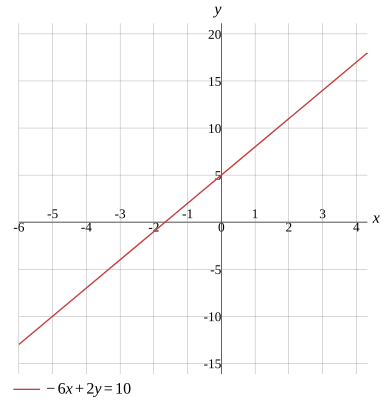
-6x+2y=10
Function
-
\text{Find the }x\text{-intercept/zero}
-
Find the y-intercept
-
Find the slope
x=-\frac{5}{3}
Evaluate
-6x+2y=10
\text{To find the }x\text{-intercept,set }y\text{=0}
-6x+2\times 0=10
Any expression multiplied by 0 equals 0
-6x+0=10
Removing 0 doesn't change the value,so remove it from the expression
-6x=10
Change the signs on both sides of the equation
6x=-10
Divide both sides
\frac{6x}{6}=\frac{-10}{6}
Divide the numbers
x=\frac{-10}{6}
Solution
More Steps
Evaluate
\frac{-10}{6}
\text{Cancel out the common factor }2
\frac{-5}{3}
\text{Use }\frac{-a}{b}=\frac{a}{-b}=-\frac{a}{b}\text{ to rewrite the fraction}
-\frac{5}{3}
x=-\frac{5}{3}
Show Solutions
Solve the equation
-
\text{Solve for }x
-
\text{Solve for }y
x=\frac{-5+y}{3}
Evaluate
-6x+2y=10
Move the expression to the right-hand side and change its sign
-6x=10-2y
Change the signs on both sides of the equation
6x=-10+2y
Divide both sides
\frac{6x}{6}=\frac{-10+2y}{6}
Divide the numbers
x=\frac{-10+2y}{6}
Solution
More Steps
Evaluate
\frac{-10+2y}{6}
Rewrite the expression
\frac{2\left(-5+y\right)}{6}
\text{Cancel out the common factor }2
\frac{-5+y}{3}
x=\frac{-5+y}{3}
Show Solutions
Testing for symmetry
-
Testing for symmetry about the origin
-
Testing for symmetry about the x-axis
-
Testing for symmetry about the y-axis
\textrm{Not symmetry with respect to the origin}
Evaluate
-6x+2y=10
\text{To test if the graph of }-6x+2y=10\text{ is symmetry with respect to the origin,substitute -x for x and -y for y}
-6\left(-x\right)+2\left(-y\right)=10
Evaluate
More Steps
Evaluate
-6\left(-x\right)+2\left(-y\right)
Multiply the numbers
6x+2\left(-y\right)
Multiply the numbers
6x-2y
6x-2y=10
Solution
\textrm{Not symmetry with respect to the origin}
Show Solutions
Rewrite the equation
-
Rewrite in polar form
-
Rewrite in standard form
-
Rewrite in slope-intercept form
r=\frac{5}{-3\cos\left(\theta \right)+\sin\left(\theta \right)}
Evaluate
-6x+2y=10
\text{To convert the equation to polar coordinates,substitute }r\cos\left(\theta \right)\text{ for }x\text{ and }r\sin\left(\theta \right)\text{ for }y
-6\cos\left(\theta \right)\times r+2\sin\left(\theta \right)\times r=10
Factor the expression
\left(-6\cos\left(\theta \right)+2\sin\left(\theta \right)\right)r=10
Solution
r=\frac{5}{-3\cos\left(\theta \right)+\sin\left(\theta \right)}
Show Solutions
Find the first derivative
-
\text{Find the derivative with respect to }x
-
\text{Find the derivative with respect to }y
\frac{dy}{dx}=3
Calculate
-6x+2y=10
Take the derivative of both sides
\frac{d}{dx}\left(-6x+2y\right)=\frac{d}{dx}\left(10\right)
Calculate the derivative
More Steps
Evaluate
\frac{d}{dx}\left(-6x+2y\right)
Use differentiation rules
\frac{d}{dx}\left(-6x\right)+\frac{d}{dx}\left(2y\right)
Evaluate the derivative
More Steps
Evaluate
\frac{d}{dx}\left(-6x\right)
\text{Use differentiation rule }\frac{d}{dx}\left(cf\left(x\right)\right)=c\times\frac{d}{dx}(f(x))
-6\times \frac{d}{dx}\left(x\right)
\text{Use }\frac{d}{dx} x^{n}=n x^{n-1}\text{ to find derivative}
-6\times 1
Any expression multiplied by 1 remains the same
-6
-6+\frac{d}{dx}\left(2y\right)
Evaluate the derivative
More Steps
Evaluate
\frac{d}{dx}\left(2y\right)
Use differentiation rules
\frac{d}{dy}\left(2y\right)\times \frac{dy}{dx}
Evaluate the derivative
2\frac{dy}{dx}
-6+2\frac{dy}{dx}
-6+2\frac{dy}{dx}=\frac{d}{dx}\left(10\right)
Calculate the derivative
-6+2\frac{dy}{dx}=0
Move the constant to the right-hand side and change its sign
2\frac{dy}{dx}=0+6
Removing 0 doesn't change the value,so remove it from the expression
2\frac{dy}{dx}=6
Divide both sides
\frac{2\frac{dy}{dx}}{2}=\frac{6}{2}
Divide the numbers
\frac{dy}{dx}=\frac{6}{2}
Solution
More Steps
Evaluate
\frac{6}{2}
Reduce the numbers
\frac{3}{1}
Calculate
3
\frac{dy}{dx}=3
Show Solutions
Find the second derivative
-
\text{Find the second derivative with respect to }x
-
\text{Find the second derivative with respect to }y
\frac{d^2y}{dx^2}=0
Calculate
-6x+2y=10
Take the derivative of both sides
\frac{d}{dx}\left(-6x+2y\right)=\frac{d}{dx}\left(10\right)
Calculate the derivative
More Steps
Evaluate
\frac{d}{dx}\left(-6x+2y\right)
Use differentiation rules
\frac{d}{dx}\left(-6x\right)+\frac{d}{dx}\left(2y\right)
Evaluate the derivative
More Steps
Evaluate
\frac{d}{dx}\left(-6x\right)
\text{Use differentiation rule }\frac{d}{dx}\left(cf\left(x\right)\right)=c\times\frac{d}{dx}(f(x))
-6\times \frac{d}{dx}\left(x\right)
\text{Use }\frac{d}{dx} x^{n}=n x^{n-1}\text{ to find derivative}
-6\times 1
Any expression multiplied by 1 remains the same
-6
-6+\frac{d}{dx}\left(2y\right)
Evaluate the derivative
More Steps
Evaluate
\frac{d}{dx}\left(2y\right)
Use differentiation rules
\frac{d}{dy}\left(2y\right)\times \frac{dy}{dx}
Evaluate the derivative
2\frac{dy}{dx}
-6+2\frac{dy}{dx}
-6+2\frac{dy}{dx}=\frac{d}{dx}\left(10\right)
Calculate the derivative
-6+2\frac{dy}{dx}=0
Move the constant to the right-hand side and change its sign
2\frac{dy}{dx}=0+6
Removing 0 doesn't change the value,so remove it from the expression
2\frac{dy}{dx}=6
Divide both sides
\frac{2\frac{dy}{dx}}{2}=\frac{6}{2}
Divide the numbers
\frac{dy}{dx}=\frac{6}{2}
Divide the numbers
More Steps
Evaluate
\frac{6}{2}
Reduce the numbers
\frac{3}{1}
Calculate
3
\frac{dy}{dx}=3
Take the derivative of both sides
\frac{d}{dx}\left(\frac{dy}{dx}\right)=\frac{d}{dx}\left(3\right)
Calculate the derivative
\frac{d^2y}{dx^2}=\frac{d}{dx}\left(3\right)
Solution
\frac{d^2y}{dx^2}=0
Show Solutions
Graph