Type a math problem or upload a photo, screenshot, handwritten question...
error msg
- Algebra
- Calculus
- Trigonometry
- Matrix
- Differential
- Integral
- Trigonometry
- Letters


Question
y=-2\left(x+1\right)^{2}-3
Function
-
Find the vertex
-
Find the axis of symmetry
-
Evaluate the derivative
-
Find the domain
-
\text{Find the }x\text{-intercept/zero}
-
Find the y-intercept
-
Find the critical numbers
-
Find the local extrema
-
Find the increasing or decreasing interval
-
Find the range
-
Find the vertical asymptotes
-
Find the horizontal asymptotes
-
Find the oblique asymptotes
-
Determine if even, odd or neither
-
Find the stationary points
-
Find the inflection points
More methods
Hide more
\left(-1,-3\right)
Evaluate
y=-2\left(x+1\right)^{2}-3
Simplify
More Steps
Evaluate
-2\left(x+1\right)^{2}-3
Expand the expression
More Steps
Calculate
-2\left(x+1\right)^{2}
Simplify
-2\left(x^{2}+2x+1\right)
Apply the distributive property
-2x^{2}-2\times 2x-2\times 1
Multiply the numbers
-2x^{2}-4x-2\times 1
Any expression multiplied by 1 remains the same
-2x^{2}-4x-2
-2x^{2}-4x-2-3
Subtract the numbers
-2x^{2}-4x-5
y=-2x^{2}-4x-5
\text{Find the }x\text{-coordinate of the vertex by substituting a=}-2\text{ and b=}-4\text{ into }x\text{ = }-\frac{b}{2a}
x=-\frac{-4}{2\left(-2\right)}
\text{Solve the equation for }x
x=-1
\text{Find the y-coordinate of the vertex by evaluating the function for }x\text{=}-1
y=-2\left(-1\right)^{2}-4\left(-1\right)-5
Calculate
More Steps
Evaluate
-2\left(-1\right)^{2}-4\left(-1\right)-5
Evaluate the power
-2\times 1-4\left(-1\right)-5
Any expression multiplied by 1 remains the same
-2-4\left(-1\right)-5
Simplify
-2+4-5
Calculate the sum or difference
-3
y=-3
Solution
\left(-1,-3\right)
x=-1
Evaluate
y=-2\left(x+1\right)^{2}-3
Simplify
More Steps
Evaluate
-2\left(x+1\right)^{2}-3
Expand the expression
More Steps
Calculate
-2\left(x+1\right)^{2}
Simplify
-2\left(x^{2}+2x+1\right)
Apply the distributive property
-2x^{2}-2\times 2x-2\times 1
Multiply the numbers
-2x^{2}-4x-2\times 1
Any expression multiplied by 1 remains the same
-2x^{2}-4x-2
-2x^{2}-4x-2-3
Subtract the numbers
-2x^{2}-4x-5
y=-2x^{2}-4x-5
\text{Find the }x\text{-coordinate of the vertex by substituting a=}-2\text{ and b=}-4\text{ into }x\text{ = }-\frac{b}{2a}
x=-\frac{-4}{2\left(-2\right)}
Solution
x=-1
y^{\prime}=-4x-4
Evaluate
y=-2\left(x+1\right)^{2}-3
Simplify
More Steps
Evaluate
-2\left(x+1\right)^{2}-3
Expand the expression
More Steps
Calculate
-2\left(x+1\right)^{2}
Simplify
-2\left(x^{2}+2x+1\right)
Apply the distributive property
-2x^{2}-2\times 2x-2\times 1
Multiply the numbers
-2x^{2}-4x-2\times 1
Any expression multiplied by 1 remains the same
-2x^{2}-4x-2
-2x^{2}-4x-2-3
Subtract the numbers
-2x^{2}-4x-5
y=-2x^{2}-4x-5
Take the derivative of both sides
y^{\prime}=\frac{d}{dx}\left(-2x^{2}-4x-5\right)
\text{Use differentiation rule }\frac{d}{dx}\left(f\left(x\right)\pm g\left(x\right)\right)=\frac{d}{dx}\left(f\left(x\right)\right)\pm \frac{d}{dx}(g(x))
y^{\prime}=-\frac{d}{dx}\left(2x^{2}\right)-\frac{d}{dx}\left(4x\right)-\frac{d}{dx}\left(5\right)
Calculate
More Steps
Calculate
\frac{d}{dx}\left(2x^{2}\right)
\text{Use differentiation rule }\frac{d}{dx}\left(cf\left(x\right)\right)=c\times\frac{d}{dx}(f(x))
2\times \frac{d}{dx}\left(x^{2}\right)
\text{Use }\frac{d}{dx} x^{n}=n x^{n-1}\text{ to find derivative}
2\times 2x
Multiply the terms
4x
y^{\prime}=-4x-\frac{d}{dx}\left(4x\right)-\frac{d}{dx}\left(5\right)
Calculate
More Steps
Calculate
\frac{d}{dx}\left(4x\right)
\text{Use differentiation rule }\frac{d}{dx}\left(cf\left(x\right)\right)=c\times\frac{d}{dx}(f(x))
4\times \frac{d}{dx}\left(x\right)
\text{Use }\frac{d}{dx} x^{n}=n x^{n-1}\text{ to find derivative}
4\times 1
Any expression multiplied by 1 remains the same
4
y^{\prime}=-4x-4-\frac{d}{dx}\left(5\right)
\text{Use }\frac{d}{dx}(c)=0\text{ to find derivative}
y^{\prime}=-4x-4-0
Solution
y^{\prime}=-4x-4
x \in \mathbb{R}
Evaluate
y=-2\left(x+1\right)^{2}-3
Separate the function into parts to determine the domain of each part
\begin{align}&\left(x+1\right)^{2}\\&x+1\end{align}
The domain of a power function is the set of all real numbers
\begin{align}&x \in \mathbb{R}\\&x+1\end{align}
The domain of a polynomial function is the set of all real numbers
\begin{align}&x \in \mathbb{R}\\&x \in \mathbb{R}\end{align}
Solution
x \in \mathbb{R}
\textrm{No x-intercept}
Evaluate
y=-2\left(x+1\right)^{2}-3
Simplify
More Steps
Evaluate
-2\left(x+1\right)^{2}-3
Expand the expression
More Steps
Calculate
-2\left(x+1\right)^{2}
Simplify
-2\left(x^{2}+2x+1\right)
Apply the distributive property
-2x^{2}-2\times 2x-2\times 1
Multiply the numbers
-2x^{2}-4x-2\times 1
Any expression multiplied by 1 remains the same
-2x^{2}-4x-2
-2x^{2}-4x-2-3
Subtract the numbers
-2x^{2}-4x-5
y=-2x^{2}-4x-5
\text{To find the }x\text{-intercept,set }y\text{=0}
0=-2x^{2}-4x-5
Swap the sides of the equation
-2x^{2}-4x-5=0
Multiply both sides
2x^{2}+4x+5=0
\text{Substitute a=}2\text{,b=}4\text{ and c=}5\text{ into the quadratic formula }x\text{=}\frac{-b\pm\sqrt{b^2-4ac}}{2a}
x=\frac{-4\pm \sqrt{4^{2}-4\times 2\times 5}}{2\times 2}
Simplify the expression
x=\frac{-4\pm \sqrt{4^{2}-4\times 2\times 5}}{4}
Simplify the expression
More Steps
Evaluate
4^{2}-4\times 2\times 5
Multiply the terms
4^{2}-40
Evaluate the power
16-40
Subtract the numbers
-24
x=\frac{-4\pm \sqrt{-24}}{4}
Simplify the radical expression
More Steps
Evaluate
\sqrt{-24}
Evaluate the power
\sqrt{24}\times \sqrt{-1}
Evaluate the power
\sqrt{24}\times i
Evaluate the power
2\sqrt{6}\times i
x=\frac{-4\pm 2\sqrt{6}\times i}{4}
\text{Separate the equation into }2\text{ possible cases}
\begin{align}&x=\frac{-4+2\sqrt{6}\times i}{4}\\&x=\frac{-4-2\sqrt{6}\times i}{4}\end{align}
Simplify the expression
\begin{align}&x=-1+\frac{\sqrt{6}}{2}i\\&x=\frac{-4-2\sqrt{6}\times i}{4}\end{align}
Simplify the expression
\begin{align}&x=-1+\frac{\sqrt{6}}{2}i\\&x=-1-\frac{\sqrt{6}}{2}i\end{align}
Calculate
x_{1}=-1-\frac{\sqrt{6}}{2}i,x_{2}=-1+\frac{\sqrt{6}}{2}i
Calculate
x \notin \mathbb{R}
Solution
\textrm{No x-intercept}
y=-5
Evaluate
y=-2\left(x+1\right)^{2}-3
Simplify
More Steps
Evaluate
-2\left(x+1\right)^{2}-3
Expand the expression
More Steps
Calculate
-2\left(x+1\right)^{2}
Simplify
-2\left(x^{2}+2x+1\right)
Apply the distributive property
-2x^{2}-2\times 2x-2\times 1
Multiply the numbers
-2x^{2}-4x-2\times 1
Any expression multiplied by 1 remains the same
-2x^{2}-4x-2
-2x^{2}-4x-2-3
Subtract the numbers
-2x^{2}-4x-5
y=-2x^{2}-4x-5
\text{To find the }y\text{-intercept,set }x\text{=0}
y=-2\times 0^{2}-4\times 0-5
Any expression multiplied by 0 equals 0
y=-2\times 0^{2}-0-5
Solution
More Steps
Evaluate
-2\times 0^{2}-0-5
Calculate
-2\times 0-0-5
Any expression multiplied by 0 equals 0
-0-0-5
Removing 0 doesn't change the value,so remove it from the expression
-5
y=-5
x=-1
Evaluate
y=-2\left(x+1\right)^{2}-3
Simplify
More Steps
Evaluate
-2\left(x+1\right)^{2}-3
Expand the expression
More Steps
Calculate
-2\left(x+1\right)^{2}
Simplify
-2\left(x^{2}+2x+1\right)
Apply the distributive property
-2x^{2}-2\times 2x-2\times 1
Multiply the numbers
-2x^{2}-4x-2\times 1
Any expression multiplied by 1 remains the same
-2x^{2}-4x-2
-2x^{2}-4x-2-3
Subtract the numbers
-2x^{2}-4x-5
y=-2x^{2}-4x-5
Rewrite the function using the appropriate notation
f\left(x\right)=-2x^{2}-4x-5
Find the domain of the function
f\left(x\right)=-2x^{2}-4x-5,x \in \mathbb{R}
Find the derivative
More Steps
Evaluate
y=-2x^{2}-4x-5
Take the derivative of both sides
y^{\prime}=\frac{d}{dx}\left(-2x^{2}-4x-5\right)
\text{Use differentiation rule }\frac{d}{dx}\left(f\left(x\right)\pm g\left(x\right)\right)=\frac{d}{dx}\left(f\left(x\right)\right)\pm \frac{d}{dx}(g(x))
y^{\prime}=-\frac{d}{dx}\left(2x^{2}\right)-\frac{d}{dx}\left(4x\right)-\frac{d}{dx}\left(5\right)
Calculate
More Steps
Calculate
\frac{d}{dx}\left(2x^{2}\right)
\text{Use differentiation rule }\frac{d}{dx}\left(cf\left(x\right)\right)=c\times\frac{d}{dx}(f(x))
2\times \frac{d}{dx}\left(x^{2}\right)
\text{Use }\frac{d}{dx} x^{n}=n x^{n-1}\text{ to find derivative}
2\times 2x
Multiply the terms
4x
y^{\prime}=-4x-\frac{d}{dx}\left(4x\right)-\frac{d}{dx}\left(5\right)
Calculate
More Steps
Calculate
\frac{d}{dx}\left(4x\right)
\text{Use differentiation rule }\frac{d}{dx}\left(cf\left(x\right)\right)=c\times\frac{d}{dx}(f(x))
4\times \frac{d}{dx}\left(x\right)
\text{Use }\frac{d}{dx} x^{n}=n x^{n-1}\text{ to find derivative}
4\times 1
Any expression multiplied by 1 remains the same
4
y^{\prime}=-4x-4-\frac{d}{dx}\left(5\right)
\text{Use }\frac{d}{dx}(c)=0\text{ to find derivative}
y^{\prime}=-4x-4-0
Removing 0 doesn't change the value,so remove it from the expression
y^{\prime}=-4x-4
Rewrite the function using the appropriate notation
f^{\prime}\left(x\right)=-4x-4
f^{\prime}\left(x\right)=-4x-4
Find the domain of the derivative within the domain of the original function
f^{\prime}\left(x\right)=-4x-4,x \in \mathbb{R}
\text{Substitute }f^{\prime}\left(x\right)=0\text{ to find the critical numbers}
0=-4x-4
Swap the sides of the equation
-4x-4=0
Move the constant to the right-hand side and change its sign
-4x=0+4
Removing 0 doesn't change the value,so remove it from the expression
-4x=4
Change the signs on both sides of the equation
4x=-4
Divide both sides
\frac{4x}{4}=\frac{-4}{4}
Divide the numbers
x=\frac{-4}{4}
Solution
More Steps
Evaluate
\frac{-4}{4}
Reduce the numbers
\frac{-1}{1}
Calculate
-1
x=-1
\begin{align}&\textrm{The local maximum is}\textrm{ }-3\textrm{ }\textrm{at}\textrm{ }x = -1\end{align}
Evaluate
y=-2\left(x+1\right)^{2}-3
Simplify
More Steps
Evaluate
-2\left(x+1\right)^{2}-3
Expand the expression
More Steps
Calculate
-2\left(x+1\right)^{2}
Simplify
-2\left(x^{2}+2x+1\right)
Apply the distributive property
-2x^{2}-2\times 2x-2\times 1
Multiply the numbers
-2x^{2}-4x-2\times 1
Any expression multiplied by 1 remains the same
-2x^{2}-4x-2
-2x^{2}-4x-2-3
Subtract the numbers
-2x^{2}-4x-5
y=-2x^{2}-4x-5
Rewrite the function using the appropriate notation
f\left(x\right)=-2x^{2}-4x-5
Find the domain of the function
f\left(x\right)=-2x^{2}-4x-5,x \in \mathbb{R}
Find the derivative
More Steps
Evaluate
y=-2x^{2}-4x-5
Take the derivative of both sides
y^{\prime}=\frac{d}{dx}\left(-2x^{2}-4x-5\right)
\text{Use differentiation rule }\frac{d}{dx}\left(f\left(x\right)\pm g\left(x\right)\right)=\frac{d}{dx}\left(f\left(x\right)\right)\pm \frac{d}{dx}(g(x))
y^{\prime}=-\frac{d}{dx}\left(2x^{2}\right)-\frac{d}{dx}\left(4x\right)-\frac{d}{dx}\left(5\right)
Calculate
More Steps
Calculate
\frac{d}{dx}\left(2x^{2}\right)
\text{Use differentiation rule }\frac{d}{dx}\left(cf\left(x\right)\right)=c\times\frac{d}{dx}(f(x))
2\times \frac{d}{dx}\left(x^{2}\right)
\text{Use }\frac{d}{dx} x^{n}=n x^{n-1}\text{ to find derivative}
2\times 2x
Multiply the terms
4x
y^{\prime}=-4x-\frac{d}{dx}\left(4x\right)-\frac{d}{dx}\left(5\right)
Calculate
More Steps
Calculate
\frac{d}{dx}\left(4x\right)
\text{Use differentiation rule }\frac{d}{dx}\left(cf\left(x\right)\right)=c\times\frac{d}{dx}(f(x))
4\times \frac{d}{dx}\left(x\right)
\text{Use }\frac{d}{dx} x^{n}=n x^{n-1}\text{ to find derivative}
4\times 1
Any expression multiplied by 1 remains the same
4
y^{\prime}=-4x-4-\frac{d}{dx}\left(5\right)
\text{Use }\frac{d}{dx}(c)=0\text{ to find derivative}
y^{\prime}=-4x-4-0
Removing 0 doesn't change the value,so remove it from the expression
y^{\prime}=-4x-4
Rewrite the function using the appropriate notation
f^{\prime}\left(x\right)=-4x-4
f^{\prime}\left(x\right)=-4x-4
Find the domain of the derivative within the domain of the original function
f^{\prime}\left(x\right)=-4x-4,x \in \mathbb{R}
\text{Substitute }f^{\prime}\left(x\right)=0\text{ to find the critical numbers}
0=-4x-4
Swap the sides of the equation
-4x-4=0
Move the constant to the right-hand side and change its sign
-4x=0+4
Removing 0 doesn't change the value,so remove it from the expression
-4x=4
Change the signs on both sides of the equation
4x=-4
Divide both sides
\frac{4x}{4}=\frac{-4}{4}
Divide the numbers
x=\frac{-4}{4}
Divide the numbers
More Steps
Evaluate
\frac{-4}{4}
Reduce the numbers
\frac{-1}{1}
Calculate
-1
x=-1
Determine the intervals around the critical point
\begin{align}&\left(-\infty,-1\right),\left(-1,+\infty\right)\end{align}
Choose one point from each interval
x_{1}=-2,x_{2}=0
Find the values of the derivatives for the chosen point
More Steps
Evaluate
f^{\prime}\left(-2\right)=-4\left(-2\right)-4
Multiply the numbers
More Steps
Evaluate
-4\left(-2\right)
Multiplying or dividing an even number of negative terms equals a positive
4\times 2
Multiply the numbers
8
f^{\prime}\left(-2\right)=8-4
Subtract the numbers
f^{\prime}\left(-2\right)=4
f^{\prime}\left(-2\right)=4,x_{2}=0
Find the values of the derivatives for the chosen point
More Steps
Evaluate
f^{\prime}\left(0\right)=-4\times 0-4
Any expression multiplied by 0 equals 0
f^{\prime}\left(0\right)=0-4
Removing 0 doesn't change the value,so remove it from the expression
f^{\prime}\left(0\right)=-4
f^{\prime}\left(-2\right)=4,f^{\prime}\left(0\right)=-4
\text{Since the derivative is positive for }x<-1\text{ and negative for }x>-1\text{,the function has a local maximum at }x=-1
\begin{align}&f\left(x\right)=-2x^{2}-4x-5,x=-1\end{align}
\text{Calculate the function value for }x=-1
More Steps
Evaluate
f\left(-1\right)=-2\left(-1\right)^{2}-4\left(-1\right)-5
Evaluate the power
f\left(-1\right)=-2\times 1-4\left(-1\right)-5
Any expression multiplied by 1 remains the same
f\left(-1\right)=-2-4\left(-1\right)-5
Simplify
f\left(-1\right)=-2+4-5
Calculate the sum or difference
f\left(-1\right)=-3
f\left(-1\right)=-3
Solution
\begin{align}&\textrm{The local maximum is}\textrm{ }-3\textrm{ }\textrm{at}\textrm{ }x = -1\end{align}
\begin{align}&\textrm{The increasing interval is}\textrm{ }x\leq -1\\&\textrm{The decreasing interval is}\textrm{ }x\geq -1\end{align}
Evaluate
y=-2\left(x+1\right)^{2}-3
Simplify
More Steps
Evaluate
-2\left(x+1\right)^{2}-3
Expand the expression
More Steps
Calculate
-2\left(x+1\right)^{2}
Simplify
-2\left(x^{2}+2x+1\right)
Apply the distributive property
-2x^{2}-2\times 2x-2\times 1
Multiply the numbers
-2x^{2}-4x-2\times 1
Any expression multiplied by 1 remains the same
-2x^{2}-4x-2
-2x^{2}-4x-2-3
Subtract the numbers
-2x^{2}-4x-5
y=-2x^{2}-4x-5
Rewrite the function using the appropriate notation
f\left(x\right)=-2x^{2}-4x-5
Find the domain of the function
f\left(x\right)=-2x^{2}-4x-5,x \in \mathbb{R}
Find the derivative
More Steps
Evaluate
y=-2x^{2}-4x-5
Take the derivative of both sides
y^{\prime}=\frac{d}{dx}\left(-2x^{2}-4x-5\right)
\text{Use differentiation rule }\frac{d}{dx}\left(f\left(x\right)\pm g\left(x\right)\right)=\frac{d}{dx}\left(f\left(x\right)\right)\pm \frac{d}{dx}(g(x))
y^{\prime}=-\frac{d}{dx}\left(2x^{2}\right)-\frac{d}{dx}\left(4x\right)-\frac{d}{dx}\left(5\right)
Calculate
More Steps
Calculate
\frac{d}{dx}\left(2x^{2}\right)
\text{Use differentiation rule }\frac{d}{dx}\left(cf\left(x\right)\right)=c\times\frac{d}{dx}(f(x))
2\times \frac{d}{dx}\left(x^{2}\right)
\text{Use }\frac{d}{dx} x^{n}=n x^{n-1}\text{ to find derivative}
2\times 2x
Multiply the terms
4x
y^{\prime}=-4x-\frac{d}{dx}\left(4x\right)-\frac{d}{dx}\left(5\right)
Calculate
More Steps
Calculate
\frac{d}{dx}\left(4x\right)
\text{Use differentiation rule }\frac{d}{dx}\left(cf\left(x\right)\right)=c\times\frac{d}{dx}(f(x))
4\times \frac{d}{dx}\left(x\right)
\text{Use }\frac{d}{dx} x^{n}=n x^{n-1}\text{ to find derivative}
4\times 1
Any expression multiplied by 1 remains the same
4
y^{\prime}=-4x-4-\frac{d}{dx}\left(5\right)
\text{Use }\frac{d}{dx}(c)=0\text{ to find derivative}
y^{\prime}=-4x-4-0
Removing 0 doesn't change the value,so remove it from the expression
y^{\prime}=-4x-4
Rewrite the function using the appropriate notation
f^{\prime}\left(x\right)=-4x-4
f^{\prime}\left(x\right)=-4x-4
Find the domain of the derivative within the domain of the original function
f^{\prime}\left(x\right)=-4x-4,x \in \mathbb{R}
\text{Substitute }f^{\prime}\left(x\right)=0\text{ to find the critical numbers}
0=-4x-4
Swap the sides of the equation
-4x-4=0
Move the constant to the right-hand side and change its sign
-4x=0+4
Removing 0 doesn't change the value,so remove it from the expression
-4x=4
Change the signs on both sides of the equation
4x=-4
Divide both sides
\frac{4x}{4}=\frac{-4}{4}
Divide the numbers
x=\frac{-4}{4}
Divide the numbers
More Steps
Evaluate
\frac{-4}{4}
Reduce the numbers
\frac{-1}{1}
Calculate
-1
x=-1
Determine the intervals according to the critical numbers and the domain of original function
\begin{align}&x\leq -1\\&x\geq -1\end{align}
Choose one point from each interval
\begin{align}&x_{1}=-2\\&x_{2}=0\end{align}
Find the values of the derivatives for the chosen point
More Steps
Evaluate
f^{\prime}\left(-2\right)=-4\left(-2\right)-4
Multiply the numbers
More Steps
Evaluate
-4\left(-2\right)
Multiplying or dividing an even number of negative terms equals a positive
4\times 2
Multiply the numbers
8
f^{\prime}\left(-2\right)=8-4
Subtract the numbers
f^{\prime}\left(-2\right)=4
\begin{align}&f^{\prime}\left(-2\right)=4\\&x_{2}=0\end{align}
Find the values of the derivatives for the chosen point
More Steps
Evaluate
f^{\prime}\left(0\right)=-4\times 0-4
Any expression multiplied by 0 equals 0
f^{\prime}\left(0\right)=0-4
Removing 0 doesn't change the value,so remove it from the expression
f^{\prime}\left(0\right)=-4
\begin{align}&f^{\prime}\left(-2\right)=4\\&f^{\prime}\left(0\right)=-4\end{align}
Calculate
\begin{align}&x\leq -1\textrm{ }\textrm{is increasing interval}\\&f^{\prime}\left(0\right)=-4\end{align}
Calculate
\begin{align}&x\leq -1\textrm{ }\textrm{is increasing interval}\\&x\geq -1\textrm{ }\textrm{is decreasing interval}\end{align}
Solution
\begin{align}&\textrm{The increasing interval is}\textrm{ }x\leq -1\\&\textrm{The decreasing interval is}\textrm{ }x\geq -1\end{align}
y\leq -3
Evaluate
y=-2\left(x+1\right)^{2}-3
Simplify
More Steps
Evaluate
-2\left(x+1\right)^{2}-3
Expand the expression
More Steps
Calculate
-2\left(x+1\right)^{2}
Simplify
-2\left(x^{2}+2x+1\right)
Apply the distributive property
-2x^{2}-2\times 2x-2\times 1
Multiply the numbers
-2x^{2}-4x-2\times 1
Any expression multiplied by 1 remains the same
-2x^{2}-4x-2
-2x^{2}-4x-2-3
Subtract the numbers
-2x^{2}-4x-5
y=-2x^{2}-4x-5
Solution
y\leq -3
\textrm{No vertical asymptotes}
Evaluate
y=-2\left(x+1\right)^{2}-3
Simplify
More Steps
Evaluate
-2\left(x+1\right)^{2}-3
Expand the expression
More Steps
Calculate
-2\left(x+1\right)^{2}
Simplify
-2\left(x^{2}+2x+1\right)
Apply the distributive property
-2x^{2}-2\times 2x-2\times 1
Multiply the numbers
-2x^{2}-4x-2\times 1
Any expression multiplied by 1 remains the same
-2x^{2}-4x-2
-2x^{2}-4x-2-3
Subtract the numbers
-2x^{2}-4x-5
y=-2x^{2}-4x-5
Find the domain
More Steps
Separate the function into parts to determine the domain of each part
\begin{align}&\left(x+1\right)^{2}\\&x+1\end{align}
The domain of a power function is the set of all real numbers
\begin{align}&x \in \mathbb{R}\\&x+1\end{align}
The domain of a polynomial function is the set of all real numbers
\begin{align}&x \in \mathbb{R}\\&x \in \mathbb{R}\end{align}
Calculate
x \in \mathbb{R}
y=-2x^{2}-4x-5,x \in \mathbb{R}
Solution
\textrm{No vertical asymptotes}
\textrm{No horizontal asymptotes}
Evaluate
y=-2\left(x+1\right)^{2}-3
Simplify
More Steps
Evaluate
-2\left(x+1\right)^{2}-3
Expand the expression
More Steps
Calculate
-2\left(x+1\right)^{2}
Simplify
-2\left(x^{2}+2x+1\right)
Apply the distributive property
-2x^{2}-2\times 2x-2\times 1
Multiply the numbers
-2x^{2}-4x-2\times 1
Any expression multiplied by 1 remains the same
-2x^{2}-4x-2
-2x^{2}-4x-2-3
Subtract the numbers
-2x^{2}-4x-5
y=-2x^{2}-4x-5
\text{To determine the horizontal asymptote,evaluate the limits }\lim _{x\rightarrow +\infty}\left(y\right)\text{ and }\lim _{x\rightarrow -\infty}\left(y\right)
\begin{align}&\lim _{x\rightarrow +\infty}\left(-2x^{2}-4x-5\right)\\&\lim _{x\rightarrow -\infty}\left(-2x^{2}-4x-5\right)\end{align}
Calculate
More Steps
Evaluate
\lim _{x\rightarrow +\infty}\left(-2x^{2}-4x-5\right)
Rewrite the expression
\lim _{x\rightarrow +\infty}\left(-2x^{2}\right)-\lim _{x\rightarrow +\infty}\left(4x\right)-\lim _{x\rightarrow +\infty}\left(5\right)
Calculate
More Steps
Evaluate
\lim _{x\rightarrow +\infty}\left(-2x^{2}\right)
Rewrite the expression
-2\times \lim _{x\rightarrow +\infty}\left(x^{2}\right)
Calculate
-2\left(+\infty\right)
Calculate
-\infty
\left(-\infty\right)-\lim _{x\rightarrow +\infty}\left(4x\right)-\lim _{x\rightarrow +\infty}\left(5\right)
Calculate
More Steps
Evaluate
\lim _{x\rightarrow +\infty}\left(4x\right)
Rewrite the expression
4\times \lim _{x\rightarrow +\infty}\left(x\right)
Calculate
4\left(+\infty\right)
Calculate
+\infty
\left(-\infty\right)-\left(+\infty\right)-\lim _{x\rightarrow +\infty}\left(5\right)
Calculate
\left(-\infty\right)-\left(+\infty\right)-5
Calculate
\left(-\infty\right)-5
Calculate
-\infty
\begin{align}&-\infty\\&\lim _{x\rightarrow -\infty}\left(-2x^{2}-4x-5\right)\end{align}
Calculate
More Steps
Evaluate
\lim _{x\rightarrow -\infty}\left(-2x^{2}-4x-5\right)
Rewrite the expression
\lim _{x\rightarrow -\infty}\left(x^{2}\left(-2-\frac{4}{x}-\frac{5}{x^{2}}\right)\right)
Rewrite the expression
\lim _{x\rightarrow -\infty}\left(x^{2}\right)\times \lim _{x\rightarrow -\infty}\left(-2-\frac{4}{x}-\frac{5}{x^{2}}\right)
Calculate
More Steps
Evaluate
\lim _{x\rightarrow -\infty}\left(x^{2}\right)
Rewrite the expression
\left(\lim _{x\rightarrow -\infty}\left(x\right)\right)^{2}
Calculate
\left(-\infty\right)^{2}
Calculate
+\infty
\left(+\infty\right)\times \lim _{x\rightarrow -\infty}\left(-2-\frac{4}{x}-\frac{5}{x^{2}}\right)
Calculate
More Steps
Evaluate
\lim _{x\rightarrow -\infty}\left(-2-\frac{4}{x}-\frac{5}{x^{2}}\right)
Rewrite the expression
\lim _{x\rightarrow -\infty}\left(-2\right)+\lim _{x\rightarrow -\infty}\left(-\frac{4}{x}\right)+\lim _{x\rightarrow -\infty}\left(-\frac{5}{x^{2}}\right)
Calculate
-2+\lim _{x\rightarrow -\infty}\left(-\frac{4}{x}\right)+\lim _{x\rightarrow -\infty}\left(-\frac{5}{x^{2}}\right)
Calculate
-2+0+\lim _{x\rightarrow -\infty}\left(-\frac{5}{x^{2}}\right)
Calculate
-2+0+0
Calculate
-2+0
Calculate
-2
\left(+\infty\right)\left(-2\right)
Rewrite the expression
-\infty
\begin{align}&-\infty\\&-\infty\end{align}
Solution
\textrm{No horizontal asymptotes}
\textrm{No oblique asymptotes}
Evaluate
y=-2\left(x+1\right)^{2}-3
Simplify
More Steps
Evaluate
-2\left(x+1\right)^{2}-3
Expand the expression
More Steps
Calculate
-2\left(x+1\right)^{2}
Simplify
-2\left(x^{2}+2x+1\right)
Apply the distributive property
-2x^{2}-2\times 2x-2\times 1
Multiply the numbers
-2x^{2}-4x-2\times 1
Any expression multiplied by 1 remains the same
-2x^{2}-4x-2
-2x^{2}-4x-2-3
Subtract the numbers
-2x^{2}-4x-5
y=-2x^{2}-4x-5
\text{To determine the slope of the oblique asymptote,evaluate the limit }\lim _{x\rightarrow +\infty}\left(\frac{y}{x}\right)\text{ and }\lim _{x\rightarrow -\infty}\left(\frac{y}{x}\right)
\begin{align}&\lim _{x\rightarrow +\infty}\left(-\frac{2x^{2}+4x+5}{x}\right)\\&\lim _{x\rightarrow -\infty}\left(-\frac{2x^{2}+4x+5}{x}\right)\end{align}
Calculate
More Steps
Evaluate
\lim _{x\rightarrow +\infty}\left(-\frac{2x^{2}+4x+5}{x}\right)
Rewrite the expression
\lim _{x\rightarrow +\infty}\left(\frac{x^{2}}{x}\times \frac{-2-\frac{4}{x}-\frac{5}{x^{2}}}{1}\right)
Calculate
\lim _{x\rightarrow +\infty}\left(x\times \frac{-2-\frac{4}{x}-\frac{5}{x^{2}}}{1}\right)
Rewrite the expression
\lim _{x\rightarrow +\infty}\left(x\right)\times \lim _{x\rightarrow +\infty}\left(\frac{-2-\frac{4}{x}-\frac{5}{x^{2}}}{1}\right)
Calculate
\lim _{x\rightarrow +\infty}\left(x\right)\times \frac{\lim _{x\rightarrow +\infty}\left(-2-\frac{4}{x}-\frac{5}{x^{2}}\right)}{\lim _{x\rightarrow +\infty}\left(1\right)}
Rewrite the expression
More Steps
Evaluate
\lim _{x\rightarrow +\infty}\left(-2-\frac{4}{x}-\frac{5}{x^{2}}\right)
Rewrite the expression
\lim _{x\rightarrow +\infty}\left(-2\right)+\lim _{x\rightarrow +\infty}\left(-\frac{4}{x}\right)+\lim _{x\rightarrow +\infty}\left(-\frac{5}{x^{2}}\right)
Calculate
-2+\lim _{x\rightarrow +\infty}\left(-\frac{4}{x}\right)+\lim _{x\rightarrow +\infty}\left(-\frac{5}{x^{2}}\right)
Calculate
-2+0+\lim _{x\rightarrow +\infty}\left(-\frac{5}{x^{2}}\right)
Calculate
-2+0+0
Calculate
-2
\lim _{x\rightarrow +\infty}\left(x\right)\times \frac{-2}{\lim _{x\rightarrow +\infty}\left(1\right)}
Rewrite the expression
\lim _{x\rightarrow +\infty}\left(x\right)\times \frac{-2}{1}
Rewrite the expression
\left(+\infty\right)\times \frac{-2}{1}
Calculate
\left(+\infty\right)\left(-2\right)
Calculate
-\infty
\begin{align}&-\infty\\&\lim _{x\rightarrow -\infty}\left(-\frac{2x^{2}+4x+5}{x}\right)\end{align}
Calculate
More Steps
Evaluate
\lim _{x\rightarrow -\infty}\left(-\frac{2x^{2}+4x+5}{x}\right)
Rewrite the expression
\lim _{x\rightarrow -\infty}\left(\frac{x^{2}}{x}\times \frac{-2-\frac{4}{x}-\frac{5}{x^{2}}}{1}\right)
Calculate
\lim _{x\rightarrow -\infty}\left(x\times \frac{-2-\frac{4}{x}-\frac{5}{x^{2}}}{1}\right)
Rewrite the expression
\lim _{x\rightarrow -\infty}\left(x\right)\times \lim _{x\rightarrow -\infty}\left(\frac{-2-\frac{4}{x}-\frac{5}{x^{2}}}{1}\right)
Calculate
\lim _{x\rightarrow -\infty}\left(x\right)\times \frac{\lim _{x\rightarrow -\infty}\left(-2-\frac{4}{x}-\frac{5}{x^{2}}\right)}{\lim _{x\rightarrow -\infty}\left(1\right)}
Rewrite the expression
More Steps
Evaluate
\lim _{x\rightarrow -\infty}\left(-2-\frac{4}{x}-\frac{5}{x^{2}}\right)
Rewrite the expression
\lim _{x\rightarrow -\infty}\left(-2\right)+\lim _{x\rightarrow -\infty}\left(-\frac{4}{x}\right)+\lim _{x\rightarrow -\infty}\left(-\frac{5}{x^{2}}\right)
Calculate
-2+\lim _{x\rightarrow -\infty}\left(-\frac{4}{x}\right)+\lim _{x\rightarrow -\infty}\left(-\frac{5}{x^{2}}\right)
Calculate
-2+0+\lim _{x\rightarrow -\infty}\left(-\frac{5}{x^{2}}\right)
Calculate
-2+0+0
Calculate
-2
\lim _{x\rightarrow -\infty}\left(x\right)\times \frac{-2}{\lim _{x\rightarrow -\infty}\left(1\right)}
Rewrite the expression
\lim _{x\rightarrow -\infty}\left(x\right)\times \frac{-2}{1}
Rewrite the expression
-\infty\times \frac{-2}{1}
Calculate
-\infty\times \left(-2\right)
Calculate
+\infty
\begin{align}&-\infty\\&+\infty\end{align}
Since the slope of the oblique asymptote is not defined,the function has no oblique asymptote
\begin{align}&\textrm{No oblique asymptotes}\\&+\infty\end{align}
Since the slope of the oblique asymptote is not defined,the function has no oblique asymptote
\begin{align}&\textrm{No oblique asymptotes}\\&\textrm{No oblique asymptotes}\end{align}
Solution
\textrm{No oblique asymptotes}
\textrm{Neither even nor odd}
Evaluate
y=-2\left(x+1\right)^{2}-3
Simplify
More Steps
Evaluate
-2\left(x+1\right)^{2}-3
Expand the expression
More Steps
Calculate
-2\left(x+1\right)^{2}
Simplify
-2\left(x^{2}+2x+1\right)
Apply the distributive property
-2x^{2}-2\times 2x-2\times 1
Multiply the numbers
-2x^{2}-4x-2\times 1
Any expression multiplied by 1 remains the same
-2x^{2}-4x-2
-2x^{2}-4x-2-3
Subtract the numbers
-2x^{2}-4x-5
y=-2x^{2}-4x-5
To determine if the function is even or odd,use the appropriate notation
f\left(x\right)=-2x^{2}-4x-5
\text{Substitute }-x\text{ for }x
f\left(-x\right)=-2\left(-x\right)^{2}-4\left(-x\right)-5
Simplify
More Steps
Evaluate
-2\left(-x\right)^{2}-4\left(-x\right)-5
Multiply the terms
-2x^{2}-4\left(-x\right)-5
Multiply the numbers
-2x^{2}+4x-5
f\left(-x\right)=-2x^{2}+4x-5
Solution
\textrm{Neither even nor odd}
\left(-1,-3\right)
Evaluate
y=-2\left(x+1\right)^{2}-3
Simplify
More Steps
Evaluate
-2\left(x+1\right)^{2}-3
Expand the expression
More Steps
Calculate
-2\left(x+1\right)^{2}
Simplify
-2\left(x^{2}+2x+1\right)
Apply the distributive property
-2x^{2}-2\times 2x-2\times 1
Multiply the numbers
-2x^{2}-4x-2\times 1
Any expression multiplied by 1 remains the same
-2x^{2}-4x-2
-2x^{2}-4x-2-3
Subtract the numbers
-2x^{2}-4x-5
y=-2x^{2}-4x-5
Solution
\left(-1,-3\right)
\textrm{No inflection points}
Evaluate
y=-2\left(x+1\right)^{2}-3
Simplify
More Steps
Evaluate
-2\left(x+1\right)^{2}-3
Expand the expression
More Steps
Calculate
-2\left(x+1\right)^{2}
Simplify
-2\left(x^{2}+2x+1\right)
Apply the distributive property
-2x^{2}-2\times 2x-2\times 1
Multiply the numbers
-2x^{2}-4x-2\times 1
Any expression multiplied by 1 remains the same
-2x^{2}-4x-2
-2x^{2}-4x-2-3
Subtract the numbers
-2x^{2}-4x-5
y=-2x^{2}-4x-5
Rewrite the function using the appropriate notation
f\left(x\right)=-2x^{2}-4x-5
Find the domain
f\left(x\right)=-2x^{2}-4x-5,x \in \mathbb{R}
Find the derivative of the function
More Steps
Evaluate
y=-2x^{2}-4x-5
Take the derivative of both sides
y^{\prime}=\frac{d}{dx}\left(-2x^{2}-4x-5\right)
\text{Use differentiation rule }\frac{d}{dx}\left(f\left(x\right)\pm g\left(x\right)\right)=\frac{d}{dx}\left(f\left(x\right)\right)\pm \frac{d}{dx}(g(x))
y^{\prime}=-\frac{d}{dx}\left(2x^{2}\right)-\frac{d}{dx}\left(4x\right)-\frac{d}{dx}\left(5\right)
Calculate
More Steps
Calculate
\frac{d}{dx}\left(2x^{2}\right)
\text{Use differentiation rule }\frac{d}{dx}\left(cf\left(x\right)\right)=c\times\frac{d}{dx}(f(x))
2\times \frac{d}{dx}\left(x^{2}\right)
\text{Use }\frac{d}{dx} x^{n}=n x^{n-1}\text{ to find derivative}
2\times 2x
Multiply the terms
4x
y^{\prime}=-4x-\frac{d}{dx}\left(4x\right)-\frac{d}{dx}\left(5\right)
Calculate
More Steps
Calculate
\frac{d}{dx}\left(4x\right)
\text{Use differentiation rule }\frac{d}{dx}\left(cf\left(x\right)\right)=c\times\frac{d}{dx}(f(x))
4\times \frac{d}{dx}\left(x\right)
\text{Use }\frac{d}{dx} x^{n}=n x^{n-1}\text{ to find derivative}
4\times 1
Any expression multiplied by 1 remains the same
4
y^{\prime}=-4x-4-\frac{d}{dx}\left(5\right)
\text{Use }\frac{d}{dx}(c)=0\text{ to find derivative}
y^{\prime}=-4x-4-0
Removing 0 doesn't change the value,so remove it from the expression
y^{\prime}=-4x-4
Rewrite the function using the appropriate notation
f^{\prime}\left(x\right)=-4x-4
f^{\prime}\left(x\right)=-4x-4
Find the second derivative of the function
More Steps
Evaluate
f^{\prime\prime}\left(x\right)=\frac{d}{dx}\left(-4x-4\right)
\text{Use differentiation rule }\frac{d}{dx}\left(f\left(x\right)\pm g\left(x\right)\right)=\frac{d}{dx}\left(f\left(x\right)\right)\pm \frac{d}{dx}(g(x))
f^{\prime\prime}\left(x\right)=-\frac{d}{dx}\left(4x\right)-\frac{d}{dx}\left(4\right)
Calculate
More Steps
Calculate
\frac{d}{dx}\left(4x\right)
\text{Use differentiation rule }\frac{d}{dx}\left(cf\left(x\right)\right)=c\times\frac{d}{dx}(f(x))
4\times \frac{d}{dx}\left(x\right)
\text{Use }\frac{d}{dx} x^{n}=n x^{n-1}\text{ to find derivative}
4\times 1
Any expression multiplied by 1 remains the same
4
f^{\prime\prime}\left(x\right)=-4-\frac{d}{dx}\left(4\right)
\text{Use }\frac{d}{dx}(c)=0\text{ to find derivative}
f^{\prime\prime}\left(x\right)=-4-0
Removing 0 doesn't change the value,so remove it from the expression
f^{\prime\prime}\left(x\right)=-4
f^{\prime\prime}\left(x\right)=-4
Find the domain of the second derivative within the domain of the original function
f^{\prime\prime}\left(x\right)=-4,x \in \mathbb{R}
\text{Substitute }f^{\prime\prime}\left(x\right)=0\text{ to find the critical numbers}
0=-4
\text{Solve the equation for }x
\textrm{false}
Solution
\textrm{No inflection points}
Show Solutions
Testing for symmetry
-
Testing for symmetry about the origin
-
Testing for symmetry about the x-axis
-
Testing for symmetry about the y-axis
\textrm{Not symmetry with respect to the origin}
Evaluate
y=-2\left(x+1\right)^{2}-3
Simplify the expression
y=-2x^{2}-4x-5
\text{To test if the graph of }y=-2x^{2}-4x-5\text{ is symmetry with respect to the origin,substitute -x for x and -y for y}
-y=-2\left(-x\right)^{2}-4\left(-x\right)-5
Simplify
More Steps
Evaluate
-2\left(-x\right)^{2}-4\left(-x\right)-5
Multiply the terms
-2x^{2}-4\left(-x\right)-5
Multiply the numbers
-2x^{2}+4x-5
-y=-2x^{2}+4x-5
Change the signs both sides
y=2x^{2}-4x+5
Solution
\textrm{Not symmetry with respect to the origin}
\textrm{Not symmetry with respect to the x-axis}
Evaluate
y=-2\left(x+1\right)^{2}-3
Simplify the expression
y=-2x^{2}-4x-5
\text{To test if the graph of }y=-2x^{2}-4x-5\text{ is symmetry with respect to the x-axis,substitute -y for y}
-y=-2x^{2}-4x-5
Change the signs both sides
y=2x^{2}+4x+5
Solution
\textrm{Not symmetry with respect to the x-axis}
\textrm{Not symmetry with respect to the y-axis}
Evaluate
y=-2\left(x+1\right)^{2}-3
Simplify the expression
y=-2x^{2}-4x-5
\text{To test if the graph of }y=-2x^{2}-4x-5\text{ is symmetry with respect to the y-axis,substitute -x for x}
y=-2\left(-x\right)^{2}-4\left(-x\right)-5
Simplify
More Steps
Evaluate
-2\left(-x\right)^{2}-4\left(-x\right)-5
Multiply the terms
-2x^{2}-4\left(-x\right)-5
Multiply the numbers
-2x^{2}+4x-5
y=-2x^{2}+4x-5
Solution
\textrm{Not symmetry with respect to the y-axis}
Show Solutions
Identify the conic
-
Find the standard equation of the parabola
-
Find the vertex of the parabola
-
Find the focus of the parabola
-
Find the directrix of the parabola
More methods
Hide more
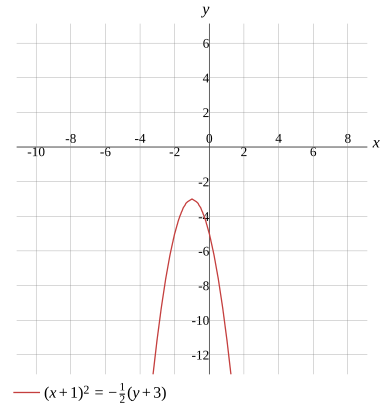
\left(x+1\right)^{2}=-\frac{1}{2}\left(y+3\right)
Evaluate
y=-2\left(x+1\right)^{2}-3
Simplify
More Steps
Evaluate
-2\left(x+1\right)^{2}-3
Expand the expression
More Steps
Calculate
-2\left(x+1\right)^{2}
Simplify
-2\left(x^{2}+2x+1\right)
Apply the distributive property
-2x^{2}-2\times 2x-2\times 1
Multiply the numbers
-2x^{2}-4x-2\times 1
Any expression multiplied by 1 remains the same
-2x^{2}-4x-2
-2x^{2}-4x-2-3
Subtract the numbers
-2x^{2}-4x-5
y=-2x^{2}-4x-5
Swap the sides of the equation
-2x^{2}-4x-5=y
Move the constant to the right-hand side and change its sign
-2x^{2}-4x=y-\left(-5\right)
If a negative sign or a subtraction symbol appears outside parentheses, remove the parentheses and change the sign of every term within the parentheses
-2x^{2}-4x=y+5
\text{Multiply both sides of the equation by }-\frac{1}{2}
\left(-2x^{2}-4x\right)\left(-\frac{1}{2}\right)=\left(y+5\right)\left(-\frac{1}{2}\right)
Multiply the terms
More Steps
Evaluate
\left(-2x^{2}-4x\right)\left(-\frac{1}{2}\right)
Use the the distributive property to expand the expression
-2x^{2}\left(-\frac{1}{2}\right)-4x\left(-\frac{1}{2}\right)
Multiply the numbers
x^{2}-4x\left(-\frac{1}{2}\right)
Multiply the numbers
x^{2}+2x
x^{2}+2x=\left(y+5\right)\left(-\frac{1}{2}\right)
Multiply the terms
More Steps
Evaluate
\left(y+5\right)\left(-\frac{1}{2}\right)
Apply the distributive property
y\left(-\frac{1}{2}\right)+5\left(-\frac{1}{2}\right)
Use the commutative property to reorder the terms
-\frac{1}{2}y+5\left(-\frac{1}{2}\right)
Multiply the numbers
-\frac{1}{2}y-\frac{5}{2}
x^{2}+2x=-\frac{1}{2}y-\frac{5}{2}
To complete the square, the same value needs to be added to both sides
x^{2}+2x+1=-\frac{1}{2}y-\frac{5}{2}+1
\text{Use }a^2+2ab+b^2=(a+b)^2\text{ to factor the expression}
\left(x+1\right)^{2}=-\frac{1}{2}y-\frac{5}{2}+1
Add the numbers
More Steps
Evaluate
-\frac{5}{2}+1
Reduce fractions to a common denominator
-\frac{5}{2}+\frac{2}{2}
Write all numerators above the common denominator
\frac{-5+2}{2}
Add the numbers
\frac{-3}{2}
\text{Use }\frac{-a}{b}=\frac{a}{-b}=-\frac{a}{b}\text{ to rewrite the fraction}
-\frac{3}{2}
\left(x+1\right)^{2}=-\frac{1}{2}y-\frac{3}{2}
Solution
\left(x+1\right)^{2}=-\frac{1}{2}\left(y+3\right)
\left(-1,-3\right)
Evaluate
y=-2\left(x+1\right)^{2}-3
Simplify
More Steps
Evaluate
-2\left(x+1\right)^{2}-3
Expand the expression
More Steps
Calculate
-2\left(x+1\right)^{2}
Simplify
-2\left(x^{2}+2x+1\right)
Apply the distributive property
-2x^{2}-2\times 2x-2\times 1
Multiply the numbers
-2x^{2}-4x-2\times 1
Any expression multiplied by 1 remains the same
-2x^{2}-4x-2
-2x^{2}-4x-2-3
Subtract the numbers
-2x^{2}-4x-5
y=-2x^{2}-4x-5
Swap the sides of the equation
-2x^{2}-4x-5=y
Move the constant to the right-hand side and change its sign
-2x^{2}-4x=y-\left(-5\right)
If a negative sign or a subtraction symbol appears outside parentheses, remove the parentheses and change the sign of every term within the parentheses
-2x^{2}-4x=y+5
\text{Multiply both sides of the equation by }-\frac{1}{2}
\left(-2x^{2}-4x\right)\left(-\frac{1}{2}\right)=\left(y+5\right)\left(-\frac{1}{2}\right)
Multiply the terms
More Steps
Evaluate
\left(-2x^{2}-4x\right)\left(-\frac{1}{2}\right)
Use the the distributive property to expand the expression
-2x^{2}\left(-\frac{1}{2}\right)-4x\left(-\frac{1}{2}\right)
Multiply the numbers
x^{2}-4x\left(-\frac{1}{2}\right)
Multiply the numbers
x^{2}+2x
x^{2}+2x=\left(y+5\right)\left(-\frac{1}{2}\right)
Multiply the terms
More Steps
Evaluate
\left(y+5\right)\left(-\frac{1}{2}\right)
Apply the distributive property
y\left(-\frac{1}{2}\right)+5\left(-\frac{1}{2}\right)
Use the commutative property to reorder the terms
-\frac{1}{2}y+5\left(-\frac{1}{2}\right)
Multiply the numbers
-\frac{1}{2}y-\frac{5}{2}
x^{2}+2x=-\frac{1}{2}y-\frac{5}{2}
To complete the square, the same value needs to be added to both sides
x^{2}+2x+1=-\frac{1}{2}y-\frac{5}{2}+1
\text{Use }a^2+2ab+b^2=(a+b)^2\text{ to factor the expression}
\left(x+1\right)^{2}=-\frac{1}{2}y-\frac{5}{2}+1
Add the numbers
More Steps
Evaluate
-\frac{5}{2}+1
Reduce fractions to a common denominator
-\frac{5}{2}+\frac{2}{2}
Write all numerators above the common denominator
\frac{-5+2}{2}
Add the numbers
\frac{-3}{2}
\text{Use }\frac{-a}{b}=\frac{a}{-b}=-\frac{a}{b}\text{ to rewrite the fraction}
-\frac{3}{2}
\left(x+1\right)^{2}=-\frac{1}{2}y-\frac{3}{2}
\text{Factor out }-\frac{1}{2}\text{ from the expression}
\left(x+1\right)^{2}=-\frac{1}{2}\left(y+3\right)
Solution
\left(-1,-3\right)
F = \left(-1,-\frac{25}{8}\right)
Evaluate
y=-2\left(x+1\right)^{2}-3
Simplify
More Steps
Evaluate
-2\left(x+1\right)^{2}-3
Expand the expression
More Steps
Calculate
-2\left(x+1\right)^{2}
Simplify
-2\left(x^{2}+2x+1\right)
Apply the distributive property
-2x^{2}-2\times 2x-2\times 1
Multiply the numbers
-2x^{2}-4x-2\times 1
Any expression multiplied by 1 remains the same
-2x^{2}-4x-2
-2x^{2}-4x-2-3
Subtract the numbers
-2x^{2}-4x-5
y=-2x^{2}-4x-5
Swap the sides of the equation
-2x^{2}-4x-5=y
Move the constant to the right-hand side and change its sign
-2x^{2}-4x=y-\left(-5\right)
If a negative sign or a subtraction symbol appears outside parentheses, remove the parentheses and change the sign of every term within the parentheses
-2x^{2}-4x=y+5
\text{Multiply both sides of the equation by }-\frac{1}{2}
\left(-2x^{2}-4x\right)\left(-\frac{1}{2}\right)=\left(y+5\right)\left(-\frac{1}{2}\right)
Multiply the terms
More Steps
Evaluate
\left(-2x^{2}-4x\right)\left(-\frac{1}{2}\right)
Use the the distributive property to expand the expression
-2x^{2}\left(-\frac{1}{2}\right)-4x\left(-\frac{1}{2}\right)
Multiply the numbers
x^{2}-4x\left(-\frac{1}{2}\right)
Multiply the numbers
x^{2}+2x
x^{2}+2x=\left(y+5\right)\left(-\frac{1}{2}\right)
Multiply the terms
More Steps
Evaluate
\left(y+5\right)\left(-\frac{1}{2}\right)
Apply the distributive property
y\left(-\frac{1}{2}\right)+5\left(-\frac{1}{2}\right)
Use the commutative property to reorder the terms
-\frac{1}{2}y+5\left(-\frac{1}{2}\right)
Multiply the numbers
-\frac{1}{2}y-\frac{5}{2}
x^{2}+2x=-\frac{1}{2}y-\frac{5}{2}
To complete the square, the same value needs to be added to both sides
x^{2}+2x+1=-\frac{1}{2}y-\frac{5}{2}+1
\text{Use }a^2+2ab+b^2=(a+b)^2\text{ to factor the expression}
\left(x+1\right)^{2}=-\frac{1}{2}y-\frac{5}{2}+1
Add the numbers
More Steps
Evaluate
-\frac{5}{2}+1
Reduce fractions to a common denominator
-\frac{5}{2}+\frac{2}{2}
Write all numerators above the common denominator
\frac{-5+2}{2}
Add the numbers
\frac{-3}{2}
\text{Use }\frac{-a}{b}=\frac{a}{-b}=-\frac{a}{b}\text{ to rewrite the fraction}
-\frac{3}{2}
\left(x+1\right)^{2}=-\frac{1}{2}y-\frac{3}{2}
\text{Factor out }-\frac{1}{2}\text{ from the expression}
\left(x+1\right)^{2}=-\frac{1}{2}\left(y+3\right)
Solution
F = \left(-1,-\frac{25}{8}\right)
y=-\frac{23}{8}
Evaluate
y=-2\left(x+1\right)^{2}-3
Simplify
More Steps
Evaluate
-2\left(x+1\right)^{2}-3
Expand the expression
More Steps
Calculate
-2\left(x+1\right)^{2}
Simplify
-2\left(x^{2}+2x+1\right)
Apply the distributive property
-2x^{2}-2\times 2x-2\times 1
Multiply the numbers
-2x^{2}-4x-2\times 1
Any expression multiplied by 1 remains the same
-2x^{2}-4x-2
-2x^{2}-4x-2-3
Subtract the numbers
-2x^{2}-4x-5
y=-2x^{2}-4x-5
Swap the sides of the equation
-2x^{2}-4x-5=y
Move the constant to the right-hand side and change its sign
-2x^{2}-4x=y-\left(-5\right)
If a negative sign or a subtraction symbol appears outside parentheses, remove the parentheses and change the sign of every term within the parentheses
-2x^{2}-4x=y+5
\text{Multiply both sides of the equation by }-\frac{1}{2}
\left(-2x^{2}-4x\right)\left(-\frac{1}{2}\right)=\left(y+5\right)\left(-\frac{1}{2}\right)
Multiply the terms
More Steps
Evaluate
\left(-2x^{2}-4x\right)\left(-\frac{1}{2}\right)
Use the the distributive property to expand the expression
-2x^{2}\left(-\frac{1}{2}\right)-4x\left(-\frac{1}{2}\right)
Multiply the numbers
x^{2}-4x\left(-\frac{1}{2}\right)
Multiply the numbers
x^{2}+2x
x^{2}+2x=\left(y+5\right)\left(-\frac{1}{2}\right)
Multiply the terms
More Steps
Evaluate
\left(y+5\right)\left(-\frac{1}{2}\right)
Apply the distributive property
y\left(-\frac{1}{2}\right)+5\left(-\frac{1}{2}\right)
Use the commutative property to reorder the terms
-\frac{1}{2}y+5\left(-\frac{1}{2}\right)
Multiply the numbers
-\frac{1}{2}y-\frac{5}{2}
x^{2}+2x=-\frac{1}{2}y-\frac{5}{2}
To complete the square, the same value needs to be added to both sides
x^{2}+2x+1=-\frac{1}{2}y-\frac{5}{2}+1
\text{Use }a^2+2ab+b^2=(a+b)^2\text{ to factor the expression}
\left(x+1\right)^{2}=-\frac{1}{2}y-\frac{5}{2}+1
Add the numbers
More Steps
Evaluate
-\frac{5}{2}+1
Reduce fractions to a common denominator
-\frac{5}{2}+\frac{2}{2}
Write all numerators above the common denominator
\frac{-5+2}{2}
Add the numbers
\frac{-3}{2}
\text{Use }\frac{-a}{b}=\frac{a}{-b}=-\frac{a}{b}\text{ to rewrite the fraction}
-\frac{3}{2}
\left(x+1\right)^{2}=-\frac{1}{2}y-\frac{3}{2}
\text{Factor out }-\frac{1}{2}\text{ from the expression}
\left(x+1\right)^{2}=-\frac{1}{2}\left(y+3\right)
Solution
y=-\frac{23}{8}
Show Solutions
Solve the equation
-
\text{Solve for }x
-
\text{Solve for }y
\begin{align}&x=\frac{\sqrt{-6-2y}-2}{2}\\&x=-\frac{\sqrt{-6-2y}+2}{2}\end{align}
Evaluate
y=-2\left(x+1\right)^{2}-3
Simplify
More Steps
Evaluate
-2\left(x+1\right)^{2}-3
Expand the expression
More Steps
Calculate
-2\left(x+1\right)^{2}
Simplify
-2\left(x^{2}+2x+1\right)
Apply the distributive property
-2x^{2}-2\times 2x-2\times 1
Multiply the numbers
-2x^{2}-4x-2\times 1
Any expression multiplied by 1 remains the same
-2x^{2}-4x-2
-2x^{2}-4x-2-3
Subtract the numbers
-2x^{2}-4x-5
y=-2x^{2}-4x-5
Swap the sides of the equation
-2x^{2}-4x-5=y
Move the expression to the left side
-2x^{2}-4x-5-y=0
Move the constant to the right side
-2x^{2}-4x=0-\left(-5-y\right)
Add the terms
-2x^{2}-4x=5+y
Evaluate
x^{2}+2x=-\frac{5+y}{2}
Add the same value to both sides
x^{2}+2x+1=-\frac{5+y}{2}+1
Evaluate
x^{2}+2x+1=-\frac{3+y}{2}
Evaluate
\left(x+1\right)^{2}=-\frac{3+y}{2}
Take the root of both sides of the equation and remember to use both positive and negative roots
x+1=\pm \sqrt{-\frac{3+y}{2}}
Simplify the expression
More Steps
Evaluate
\sqrt{-\frac{3+y}{2}}
To take a root of a fraction,take the root of the numerator and denominator separately
\frac{\sqrt{-3-y}}{\sqrt{2}}
Multiply by the Conjugate
\frac{\sqrt{-3-y}\times \sqrt{2}}{\sqrt{2}\times \sqrt{2}}
Calculate
\frac{\sqrt{-3-y}\times \sqrt{2}}{2}
Calculate
More Steps
Evaluate
\sqrt{-3-y}\times \sqrt{2}
The product of roots with the same index is equal to the root of the product
\sqrt{\left(-3-y\right)\times 2}
Calculate the product
\sqrt{-6-2y}
\frac{\sqrt{-6-2y}}{2}
x+1=\pm \frac{\sqrt{-6-2y}}{2}
\text{Separate the equation into }2\text{ possible cases}
\begin{align}&x+1=\frac{\sqrt{-6-2y}}{2}\\&x+1=-\frac{\sqrt{-6-2y}}{2}\end{align}
Calculate
More Steps
Evaluate
x+1=\frac{\sqrt{-6-2y}}{2}
Move the constant to the right-hand side and change its sign
x=\frac{\sqrt{-6-2y}}{2}-1
Subtract the terms
More Steps
Evaluate
\frac{\sqrt{-6-2y}}{2}-1
Reduce fractions to a common denominator
\frac{\sqrt{-6-2y}}{2}-\frac{2}{2}
Write all numerators above the common denominator
\frac{\sqrt{-6-2y}-2}{2}
x=\frac{\sqrt{-6-2y}-2}{2}
\begin{align}&x=\frac{\sqrt{-6-2y}-2}{2}\\&x+1=-\frac{\sqrt{-6-2y}}{2}\end{align}
Solution
More Steps
Evaluate
x+1=-\frac{\sqrt{-6-2y}}{2}
Move the constant to the right-hand side and change its sign
x=-\frac{\sqrt{-6-2y}}{2}-1
Subtract the terms
More Steps
Evaluate
-\frac{\sqrt{-6-2y}}{2}-1
Reduce fractions to a common denominator
-\frac{\sqrt{-6-2y}}{2}-\frac{2}{2}
Write all numerators above the common denominator
\frac{-\sqrt{-6-2y}-2}{2}
\text{Use }\frac{-a}{b}=\frac{a}{-b}=-\frac{a}{b}\text{ to rewrite the fraction}
-\frac{\sqrt{-6-2y}+2}{2}
x=-\frac{\sqrt{-6-2y}+2}{2}
\begin{align}&x=\frac{\sqrt{-6-2y}-2}{2}\\&x=-\frac{\sqrt{-6-2y}+2}{2}\end{align}
y=-2x^{2}-4x-5
Evaluate
y=-2\left(x+1\right)^{2}-3
Solution
More Steps
Evaluate
-2\left(x+1\right)^{2}-3
Expand the expression
More Steps
Calculate
-2\left(x+1\right)^{2}
Simplify
-2\left(x^{2}+2x+1\right)
Apply the distributive property
-2x^{2}-2\times 2x-2\times 1
Multiply the numbers
-2x^{2}-4x-2\times 1
Any expression multiplied by 1 remains the same
-2x^{2}-4x-2
-2x^{2}-4x-2-3
Subtract the numbers
-2x^{2}-4x-5
y=-2x^{2}-4x-5
Show Solutions
Rewrite the equation
\begin{align}&r=\frac{-\sin\left(\theta \right)-4\cos\left(\theta \right)+\sqrt{1-25\cos^{2}\left(\theta \right)+4\sin\left(2\theta \right)}}{4\cos^{2}\left(\theta \right)}\\&r=-\frac{\sin\left(\theta \right)+4\cos\left(\theta \right)+\sqrt{1-25\cos^{2}\left(\theta \right)+4\sin\left(2\theta \right)}}{4\cos^{2}\left(\theta \right)}\end{align}
Evaluate
y=-2\left(x+1\right)^{2}-3
Simplify
More Steps
Evaluate
-2\left(x+1\right)^{2}-3
Expand the expression
More Steps
Calculate
-2\left(x+1\right)^{2}
Simplify
-2\left(x^{2}+2x+1\right)
Apply the distributive property
-2x^{2}-2\times 2x-2\times 1
Multiply the numbers
-2x^{2}-4x-2\times 1
Any expression multiplied by 1 remains the same
-2x^{2}-4x-2
-2x^{2}-4x-2-3
Subtract the numbers
-2x^{2}-4x-5
y=-2x^{2}-4x-5
Move the expression to the left side
y+2x^{2}+4x=-5
\text{To convert the equation to polar coordinates,substitute }r\cos\left(\theta \right)\text{ for }x\text{ and }r\sin\left(\theta \right)\text{ for }y
\sin\left(\theta \right)\times r+2\left(\cos\left(\theta \right)\times r\right)^{2}+4\cos\left(\theta \right)\times r=-5
Factor the expression
2\cos^{2}\left(\theta \right)\times r^{2}+\left(\sin\left(\theta \right)+4\cos\left(\theta \right)\right)r=-5
Subtract the terms
2\cos^{2}\left(\theta \right)\times r^{2}+\left(\sin\left(\theta \right)+4\cos\left(\theta \right)\right)r-\left(-5\right)=-5-\left(-5\right)
Evaluate
2\cos^{2}\left(\theta \right)\times r^{2}+\left(\sin\left(\theta \right)+4\cos\left(\theta \right)\right)r+5=0
Solve using the quadratic formula
r=\frac{-\sin\left(\theta \right)-4\cos\left(\theta \right)\pm \sqrt{\left(\sin\left(\theta \right)+4\cos\left(\theta \right)\right)^{2}-4\times 2\cos^{2}\left(\theta \right)\times 5}}{4\cos^{2}\left(\theta \right)}
Simplify
r=\frac{-\sin\left(\theta \right)-4\cos\left(\theta \right)\pm \sqrt{1-25\cos^{2}\left(\theta \right)+4\sin\left(2\theta \right)}}{4\cos^{2}\left(\theta \right)}
\text{Separate the equation into }2\text{ possible cases}
\begin{align}&r=\frac{-\sin\left(\theta \right)-4\cos\left(\theta \right)+\sqrt{1-25\cos^{2}\left(\theta \right)+4\sin\left(2\theta \right)}}{4\cos^{2}\left(\theta \right)}\\&r=\frac{-\sin\left(\theta \right)-4\cos\left(\theta \right)-\sqrt{1-25\cos^{2}\left(\theta \right)+4\sin\left(2\theta \right)}}{4\cos^{2}\left(\theta \right)}\end{align}
Solution
\begin{align}&r=\frac{-\sin\left(\theta \right)-4\cos\left(\theta \right)+\sqrt{1-25\cos^{2}\left(\theta \right)+4\sin\left(2\theta \right)}}{4\cos^{2}\left(\theta \right)}\\&r=-\frac{\sin\left(\theta \right)+4\cos\left(\theta \right)+\sqrt{1-25\cos^{2}\left(\theta \right)+4\sin\left(2\theta \right)}}{4\cos^{2}\left(\theta \right)}\end{align}
Show Solutions
Graph