Type a math problem or upload a photo, screenshot, handwritten question...
error msg
- Differential
- Integral
- Trigonometry
- Letters
- Algebra
- Calculus
- Trigonometry
- Matrix


Question
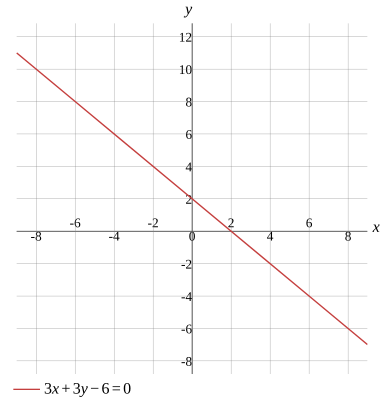
3x+3y-6=0
Function
-
\text{Find the }x\text{-intercept/zero}
-
Find the y-intercept
-
Find the slope
x=2
Evaluate
3x+3y-6=0
\text{To find the }x\text{-intercept,set }y\text{=0}
3x+3\times 0-6=0
Any expression multiplied by 0 equals 0
3x+0-6=0
Removing 0 doesn't change the value,so remove it from the expression
3x-6=0
Move the constant to the right-hand side and change its sign
3x=0+6
Removing 0 doesn't change the value,so remove it from the expression
3x=6
Divide both sides
\frac{3x}{3}=\frac{6}{3}
Divide the numbers
x=\frac{6}{3}
Solution
More Steps
Evaluate
\frac{6}{3}
Reduce the numbers
\frac{2}{1}
Calculate
2
x=2
y=2
Evaluate
3x+3y-6=0
\text{To find the }y\text{-intercept,set }x\text{=0}
3\times 0+3y-6=0
Any expression multiplied by 0 equals 0
0+3y-6=0
Removing 0 doesn't change the value,so remove it from the expression
3y-6=0
Move the constant to the right-hand side and change its sign
3y=0+6
Removing 0 doesn't change the value,so remove it from the expression
3y=6
Divide both sides
\frac{3y}{3}=\frac{6}{3}
Divide the numbers
y=\frac{6}{3}
Solution
More Steps
Evaluate
\frac{6}{3}
Reduce the numbers
\frac{2}{1}
Calculate
2
y=2
m=-1
Evaluate
3x+3y-6=0
Rewrite the expression
3x-6+3y=0
Move the expression to the right-hand side and change its sign
3y=0-\left(3x-6\right)
Subtract the terms
More Steps
Evaluate
0-\left(3x-6\right)
If a negative sign or a subtraction symbol appears outside parentheses, remove the parentheses and change the sign of every term within the parentheses
0-3x+6
Removing 0 doesn't change the value,so remove it from the expression
-3x+6
3y=-3x+6
Divide both sides
\frac{3y}{3}=\frac{-3x+6}{3}
Divide the numbers
y=\frac{-3x+6}{3}
Divide the numbers
More Steps
Evaluate
\frac{-3x+6}{3}
Rewrite the expression
\frac{3\left(-x+2\right)}{3}
Reduce the fraction
-x+2
y=-x+2
Solution
m=-1
Show Solutions
Solve the equation
-
\text{Solve for }x
-
\text{Solve for }y
x=-y+2
Evaluate
3x+3y-6=0
Move the expression to the right-hand side and change its sign
3x=0-\left(3y-6\right)
Subtract the terms
More Steps
Evaluate
0-\left(3y-6\right)
If a negative sign or a subtraction symbol appears outside parentheses, remove the parentheses and change the sign of every term within the parentheses
0-3y+6
Removing 0 doesn't change the value,so remove it from the expression
-3y+6
3x=-3y+6
Divide both sides
\frac{3x}{3}=\frac{-3y+6}{3}
Divide the numbers
x=\frac{-3y+6}{3}
Solution
More Steps
Evaluate
\frac{-3y+6}{3}
Rewrite the expression
\frac{3\left(-y+2\right)}{3}
Reduce the fraction
-y+2
x=-y+2
y=-x+2
Evaluate
3x+3y-6=0
Rewrite the expression
3x-6+3y=0
Move the expression to the right-hand side and change its sign
3y=0-\left(3x-6\right)
Subtract the terms
More Steps
Evaluate
0-\left(3x-6\right)
If a negative sign or a subtraction symbol appears outside parentheses, remove the parentheses and change the sign of every term within the parentheses
0-3x+6
Removing 0 doesn't change the value,so remove it from the expression
-3x+6
3y=-3x+6
Divide both sides
\frac{3y}{3}=\frac{-3x+6}{3}
Divide the numbers
y=\frac{-3x+6}{3}
Solution
More Steps
Evaluate
\frac{-3x+6}{3}
Rewrite the expression
\frac{3\left(-x+2\right)}{3}
Reduce the fraction
-x+2
y=-x+2
Show Solutions
Testing for symmetry
-
Testing for symmetry about the origin
-
Testing for symmetry about the x-axis
-
Testing for symmetry about the y-axis
\textrm{Not symmetry with respect to the origin}
Evaluate
3x+3y-6=0
\text{To test if the graph of }3x+3y-6=0\text{ is symmetry with respect to the origin,substitute -x for x and -y for y}
3\left(-x\right)+3\left(-y\right)-6=0
Evaluate
More Steps
Evaluate
3\left(-x\right)+3\left(-y\right)-6
Multiply the numbers
-3x+3\left(-y\right)-6
Multiply the numbers
-3x-3y-6
-3x-3y-6=0
Solution
\textrm{Not symmetry with respect to the origin}
\textrm{Not symmetry with respect to the x-axis}
Evaluate
3x+3y-6=0
\text{To test if the graph of }3x+3y-6=0\text{ is symmetry with respect to the x-axis,substitute -y for y}
3x+3\left(-y\right)-6=0
Evaluate
3x-3y-6=0
Solution
\textrm{Not symmetry with respect to the x-axis}
\textrm{Not symmetry with respect to the y-axis}
Evaluate
3x+3y-6=0
\text{To test if the graph of }3x+3y-6=0\text{ is symmetry with respect to the y-axis,substitute -x for x}
3\left(-x\right)+3y-6=0
Evaluate
-3x+3y-6=0
Solution
\textrm{Not symmetry with respect to the y-axis}
Show Solutions
Rewrite the equation
-
Rewrite in polar form
-
Rewrite in standard form
-
Rewrite in slope-intercept form
r=\frac{2}{\cos\left(\theta \right)+\sin\left(\theta \right)}
Evaluate
3x+3y-6=0
\text{To convert the equation to polar coordinates,substitute }r\cos\left(\theta \right)\text{ for }x\text{ and }r\sin\left(\theta \right)\text{ for }y
3\cos\left(\theta \right)\times r+3\sin\left(\theta \right)\times r-6=0
Factor the expression
\left(3\cos\left(\theta \right)+3\sin\left(\theta \right)\right)r-6=0
Subtract the terms
\left(3\cos\left(\theta \right)+3\sin\left(\theta \right)\right)r-6-\left(-6\right)=0-\left(-6\right)
Evaluate
\left(3\cos\left(\theta \right)+3\sin\left(\theta \right)\right)r=6
Solution
r=\frac{2}{\cos\left(\theta \right)+\sin\left(\theta \right)}
x+y=2
Evaluate
3x+3y-6=0
Move the constant to the right side
3x+3y=6
Solution
x+y=2
y=-x+2
Evaluate
3x+3y-6=0
Move the expression to the right side
3y-6=-3x
Move the constant to the right side
3y=-3x+6
Solution
y=-x+2
Show Solutions
Find the first derivative
-
\text{Find the derivative with respect to }x
-
\text{Find the derivative with respect to }y
\frac{dy}{dx}=-1
Calculate
3x+3y-6=0
Take the derivative of both sides
\frac{d}{dx}\left(3x+3y-6\right)=\frac{d}{dx}\left(0\right)
Calculate the derivative
More Steps
Evaluate
\frac{d}{dx}\left(3x+3y-6\right)
Use differentiation rules
\frac{d}{dx}\left(3x\right)+\frac{d}{dx}\left(3y\right)+\frac{d}{dx}\left(-6\right)
Evaluate the derivative
More Steps
Evaluate
\frac{d}{dx}\left(3x\right)
\text{Use differentiation rule }\frac{d}{dx}\left(cf\left(x\right)\right)=c\times\frac{d}{dx}(f(x))
3\times \frac{d}{dx}\left(x\right)
\text{Use }\frac{d}{dx} x^{n}=n x^{n-1}\text{ to find derivative}
3\times 1
Any expression multiplied by 1 remains the same
3
3+\frac{d}{dx}\left(3y\right)+\frac{d}{dx}\left(-6\right)
Evaluate the derivative
More Steps
Evaluate
\frac{d}{dx}\left(3y\right)
Use differentiation rules
\frac{d}{dy}\left(3y\right)\times \frac{dy}{dx}
Evaluate the derivative
3\frac{dy}{dx}
3+3\frac{dy}{dx}+\frac{d}{dx}\left(-6\right)
\text{Use }\frac{d}{dx}(c)=0\text{ to find derivative}
3+3\frac{dy}{dx}+0
Evaluate
3+3\frac{dy}{dx}
3+3\frac{dy}{dx}=\frac{d}{dx}\left(0\right)
Calculate the derivative
3+3\frac{dy}{dx}=0
Move the constant to the right-hand side and change its sign
3\frac{dy}{dx}=0-3
Removing 0 doesn't change the value,so remove it from the expression
3\frac{dy}{dx}=-3
Divide both sides
\frac{3\frac{dy}{dx}}{3}=\frac{-3}{3}
Divide the numbers
\frac{dy}{dx}=\frac{-3}{3}
Solution
More Steps
Evaluate
\frac{-3}{3}
Reduce the numbers
\frac{-1}{1}
Calculate
-1
\frac{dy}{dx}=-1
\frac{dx}{dy}=-1
Calculate
3x+3y-6=0
Take the derivative of both sides
\frac{d}{dy}\left(3x+3y-6\right)=\frac{d}{dy}\left(0\right)
Calculate the derivative
More Steps
Evaluate
\frac{d}{dy}\left(3x+3y-6\right)
Use differentiation rules
\frac{d}{dy}\left(3x\right)+\frac{d}{dy}\left(3y\right)+\frac{d}{dy}\left(-6\right)
Evaluate the derivative
More Steps
Evaluate
\frac{d}{dy}\left(3x\right)
Use differentiation rules
\frac{d}{dx}\left(3x\right)\times \frac{dx}{dy}
Evaluate the derivative
3\frac{dx}{dy}
3\frac{dx}{dy}+\frac{d}{dy}\left(3y\right)+\frac{d}{dy}\left(-6\right)
Evaluate the derivative
More Steps
Evaluate
\frac{d}{dy}\left(3y\right)
\text{Use differentiation rule }\frac{d}{dx}\left(cf\left(x\right)\right)=c\times\frac{d}{dx}(f(x))
3\times \frac{d}{dy}\left(y\right)
\text{Use }\frac{d}{dx} x^{n}=n x^{n-1}\text{ to find derivative}
3\times 1
Any expression multiplied by 1 remains the same
3
3\frac{dx}{dy}+3+\frac{d}{dy}\left(-6\right)
\text{Use }\frac{d}{dx}(c)=0\text{ to find derivative}
3\frac{dx}{dy}+3+0
Evaluate
3\frac{dx}{dy}+3
3\frac{dx}{dy}+3=\frac{d}{dy}\left(0\right)
Calculate the derivative
3\frac{dx}{dy}+3=0
Move the constant to the right-hand side and change its sign
3\frac{dx}{dy}=0-3
Removing 0 doesn't change the value,so remove it from the expression
3\frac{dx}{dy}=-3
Divide both sides
\frac{3\frac{dx}{dy}}{3}=\frac{-3}{3}
Divide the numbers
\frac{dx}{dy}=\frac{-3}{3}
Solution
More Steps
Evaluate
\frac{-3}{3}
Reduce the numbers
\frac{-1}{1}
Calculate
-1
\frac{dx}{dy}=-1
Show Solutions
Find the second derivative
-
\text{Find the second derivative with respect to }x
-
\text{Find the second derivative with respect to }y
\frac{d^2y}{dx^2}=0
Calculate
3x+3y-6=0
Take the derivative of both sides
\frac{d}{dx}\left(3x+3y-6\right)=\frac{d}{dx}\left(0\right)
Calculate the derivative
More Steps
Evaluate
\frac{d}{dx}\left(3x+3y-6\right)
Use differentiation rules
\frac{d}{dx}\left(3x\right)+\frac{d}{dx}\left(3y\right)+\frac{d}{dx}\left(-6\right)
Evaluate the derivative
More Steps
Evaluate
\frac{d}{dx}\left(3x\right)
\text{Use differentiation rule }\frac{d}{dx}\left(cf\left(x\right)\right)=c\times\frac{d}{dx}(f(x))
3\times \frac{d}{dx}\left(x\right)
\text{Use }\frac{d}{dx} x^{n}=n x^{n-1}\text{ to find derivative}
3\times 1
Any expression multiplied by 1 remains the same
3
3+\frac{d}{dx}\left(3y\right)+\frac{d}{dx}\left(-6\right)
Evaluate the derivative
More Steps
Evaluate
\frac{d}{dx}\left(3y\right)
Use differentiation rules
\frac{d}{dy}\left(3y\right)\times \frac{dy}{dx}
Evaluate the derivative
3\frac{dy}{dx}
3+3\frac{dy}{dx}+\frac{d}{dx}\left(-6\right)
\text{Use }\frac{d}{dx}(c)=0\text{ to find derivative}
3+3\frac{dy}{dx}+0
Evaluate
3+3\frac{dy}{dx}
3+3\frac{dy}{dx}=\frac{d}{dx}\left(0\right)
Calculate the derivative
3+3\frac{dy}{dx}=0
Move the constant to the right-hand side and change its sign
3\frac{dy}{dx}=0-3
Removing 0 doesn't change the value,so remove it from the expression
3\frac{dy}{dx}=-3
Divide both sides
\frac{3\frac{dy}{dx}}{3}=\frac{-3}{3}
Divide the numbers
\frac{dy}{dx}=\frac{-3}{3}
Divide the numbers
More Steps
Evaluate
\frac{-3}{3}
Reduce the numbers
\frac{-1}{1}
Calculate
-1
\frac{dy}{dx}=-1
Take the derivative of both sides
\frac{d}{dx}\left(\frac{dy}{dx}\right)=\frac{d}{dx}\left(-1\right)
Calculate the derivative
\frac{d^2y}{dx^2}=\frac{d}{dx}\left(-1\right)
Solution
\frac{d^2y}{dx^2}=0
\frac{d^2x}{dy^2}=0
Calculate
3x+3y-6=0
Take the derivative of both sides
\frac{d}{dy}\left(3x+3y-6\right)=\frac{d}{dy}\left(0\right)
Calculate the derivative
More Steps
Evaluate
\frac{d}{dy}\left(3x+3y-6\right)
Use differentiation rules
\frac{d}{dy}\left(3x\right)+\frac{d}{dy}\left(3y\right)+\frac{d}{dy}\left(-6\right)
Evaluate the derivative
More Steps
Evaluate
\frac{d}{dy}\left(3x\right)
Use differentiation rules
\frac{d}{dx}\left(3x\right)\times \frac{dx}{dy}
Evaluate the derivative
3\frac{dx}{dy}
3\frac{dx}{dy}+\frac{d}{dy}\left(3y\right)+\frac{d}{dy}\left(-6\right)
Evaluate the derivative
More Steps
Evaluate
\frac{d}{dy}\left(3y\right)
\text{Use differentiation rule }\frac{d}{dx}\left(cf\left(x\right)\right)=c\times\frac{d}{dx}(f(x))
3\times \frac{d}{dy}\left(y\right)
\text{Use }\frac{d}{dx} x^{n}=n x^{n-1}\text{ to find derivative}
3\times 1
Any expression multiplied by 1 remains the same
3
3\frac{dx}{dy}+3+\frac{d}{dy}\left(-6\right)
\text{Use }\frac{d}{dx}(c)=0\text{ to find derivative}
3\frac{dx}{dy}+3+0
Evaluate
3\frac{dx}{dy}+3
3\frac{dx}{dy}+3=\frac{d}{dy}\left(0\right)
Calculate the derivative
3\frac{dx}{dy}+3=0
Move the constant to the right-hand side and change its sign
3\frac{dx}{dy}=0-3
Removing 0 doesn't change the value,so remove it from the expression
3\frac{dx}{dy}=-3
Divide both sides
\frac{3\frac{dx}{dy}}{3}=\frac{-3}{3}
Divide the numbers
\frac{dx}{dy}=\frac{-3}{3}
Divide the numbers
More Steps
Evaluate
\frac{-3}{3}
Reduce the numbers
\frac{-1}{1}
Calculate
-1
\frac{dx}{dy}=-1
Take the derivative of both sides
\frac{d}{dy}\left(\frac{dx}{dy}\right)=\frac{d}{dy}\left(-1\right)
Calculate the derivative
\frac{d^2x}{dy^2}=\frac{d}{dy}\left(-1\right)
Solution
\frac{d^2x}{dy^2}=0
Show Solutions
Graph